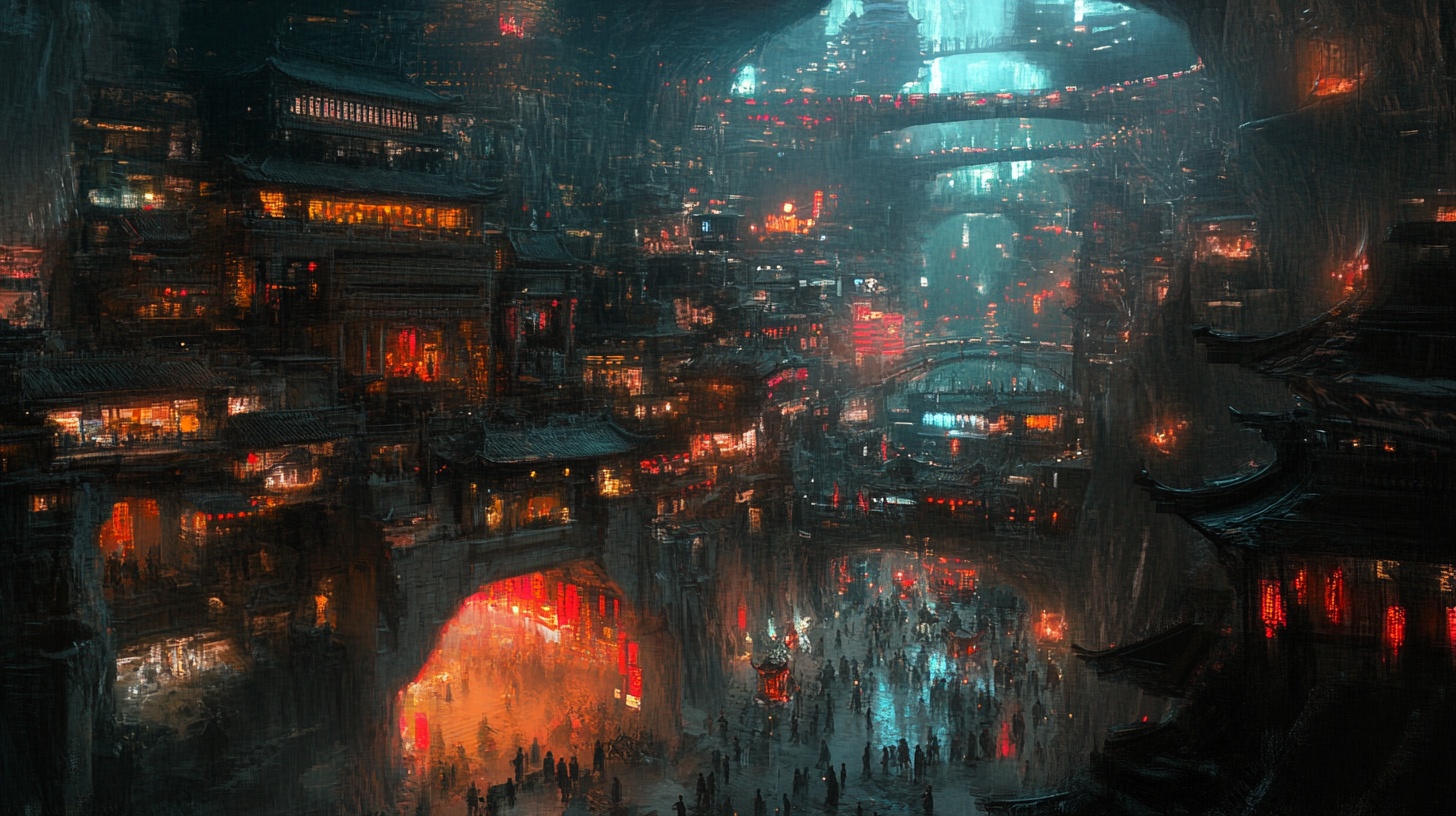
Deep within the recesses of Legere, the people of Nekrosaka toil to survive. Dim light shines upon streets flanked by towering buildings, bloated with a population that has grown too quickly. Monsters crawl through the lowest and highest levels of the city alike. The steely clash of weapons echoes from within dark alleys.
Nekrosaka was a sprawling subterranean prison-city filled with citizens that had inherited the status of prisoner from long dead ancestors. Situated in the bowels of Legere’s subterranean world, Nekrosaka ’s people engaged in a daily battle to feed themselves, fend off monsters, and keep their lights on. It was a dangerous place where enemies were honest and allies traitorous.
Nekrosaka was established as a Songkram prison colony just after the Eastern Civil War. It was built on the western shores of Fereina, just north of The Winding Strait.
History
Nekrosaka was founded originally as a small Isutan mining colony on Fereina in 200 DHT. It remained relatively small and isolated until around 70 years later, where the Songkram government looked to accelerate its mining operations to fuel the rapid expansion of its military. Nekrosaka was rich in magical crystals, basic metals required to produce Starsteel, and other treasures of the earth. Additionally, Nekrosaka’s deepest depths were the home of a massive corpulent structure that Nekrosakans called the Corpse of Niseki.
Seeded with Prisoners
To populate Nekrosaka with the workers needed to accelerate its mining operations, the Songkram sent prisoners from The Eastern Provinces on Hohm to Nekrosaka. Many of the initial prisoners were Ganpoumi Fi loyalists, critics of the Grand Lord Koh, or others who the Songkram deemed to be too politically antagonistic. After this initial seeding of Nekrosaka by prisoners, the population growth of the city would exponentially increase, causing major infrastructure issues.
Nekrosakan Law
All Nekrosakans were officially prisoners under Songkram law. A dense spiderweb of technicalities and legalities meant that every citizen born from one or more prisoner parents was also a prisoner of Nekrosaka. Thus, none were free to escape from the oppression of the Bornu.
Bornu Sovereignty
Following the collapse of the Songkram Empire in 334 DHT (after the Legerian War), Nekrosaka would creep into independence, as the ruling Nekrosakan lords—the Bornu family—took measures to ensure their lordship over the city remained unchallenged and stable. It wouldn’t be until the Kenha sought the aid of the Archangel’s Heroes that Nekrosaka would be freed from the Bornu’s grasp.
Major Locations
Dailan
Dailan was the closest of Nekrosaka’s urban sprawls to its mines. It was where the poorest of Nekrosakans lived, and those who resided there were frequently slaughtered by the creatures that stalked the mines and the Niseki Caverns.
Deepstar Mines
The primary mines of Nekrosaka before the discovery of the Corpse of Niseki was the massive network of tunnels known as the Deepstar Mines. As the mines expanded, so did the limits of Nekrosaka.
Lah Ding
Lah Ding was a small part of Nekrosaka that extended out from the underground and surrounded the Fereinan shores nearest to it. Lah Ding was a primarily military district, rife with Songkram Nakai. After the collapse of the empire, Lah Ding became saturated with new Bornu-loyal nakai.
Lah Ding’s purpose was to control the import and export of people and materials. All merchants that came to Nekrosaka—whether Songkram-affiliated or not—had to enter into Lah Ding Port for inspection. Lah Ding was heavily fortified as well, helping it to repel any hostile forces that may have sought to raid the city (or free its prisoner occupants).
Niseki Caverns
Corpse of Niseki
In 271 DHT, newly launched deep mining operations into the deepest parts of Nekrosaka were made in an attempt to open up a sister mine to the already established Deepstar Mines. As the slave-miners feverishly dug, they broke into a cavernous labyrinth that was humid, stench-filled, and pulsating to the beat of some eldritch heart. The ancient stone brickwork of the tunnels were mortared together by a quivering, bluish flesh, and the various pieces of stone with engraved with glowing runes of unintelligible meaning.
While the initial thought was that this place was a Sculptoris-infested tunnel system, more scholarly individuals were able to identify that the flesh that held the stonework together was something else entirely.
Named after the pagan Isutan goddess of sculpting, the Niseki Caverns became known as a deadly maze filled with half-stone, half-organic cyborg monsters.
Niseki, Goddess of Flesh & Stone
The primeval entity of Niseki was postulated by Isutan scholars long ago, before the unification of the Eastern Provinces. The formation of Legere and mankind was attributed to her.
Niseki was a goddess who indulged in sculpting. She used water to sculpt the flesh of the earth (stone) while gently molding Humans out of flesh.
Belief in Niseki was shattered after the Demon Wars.
Speculation & Research
Nekrosakans and other Legerian experts aware of the caverns endlessly pondered what it was. The widespread consensus was that the Corpse of Niseki was exactly what it said: the corpse of some primordial Legerian entity. The more academically-minded chose a different explanation, which was that this corpse was actually the remains of some sort of ancient Fereinan superweapon implemented in the days before the Amaranthine Reaping. Other intellectuals believe “Niseki” to be nothing more than a very large, very advanced machine that has since fallen silent.
The only thing truly clear was that if the caverns were indeed once a living organism, it had a body of flesh with bones of stone. Nekrosakan scholars likened this ancient creature to a golem with living tissue connecting its various stone organs and other body parts together. The stone components were coated in glowing, magical glyphs and runes that were far too complex and aged to truly understand. However, like a student fumbling to write in a language they didn’t fully grasp, some accomplished Nekrosakan mages found ways of gaining control or altering the function of these stone pieces by changing or inscribing new symbols into the rockface.
Stone from here, often called nisekite, had an affinity for living flesh. This allowed it to be easily implanted into the bodies of Nekrosakan hosts, giving them newfound strength, speed, intelligence, and other abilities. This new technology, dubbed lithonatomy, became uniquitous across Nekrosaka. People who underwent this body modification were referred to as the augmented. One might argue that lithonatomical augmentation was actually a requirement to survive Nekrosaka, although there were plenty who preferred to avoid modifying their bodies in this way. The Bornu begrudgingly allowed the proliferation of such technology because it improved the efficiency of their subjects, but it also became a significant boon for certain anti-Bornu factions, like the Kenha.
Local Fauna
Link to originalShigai
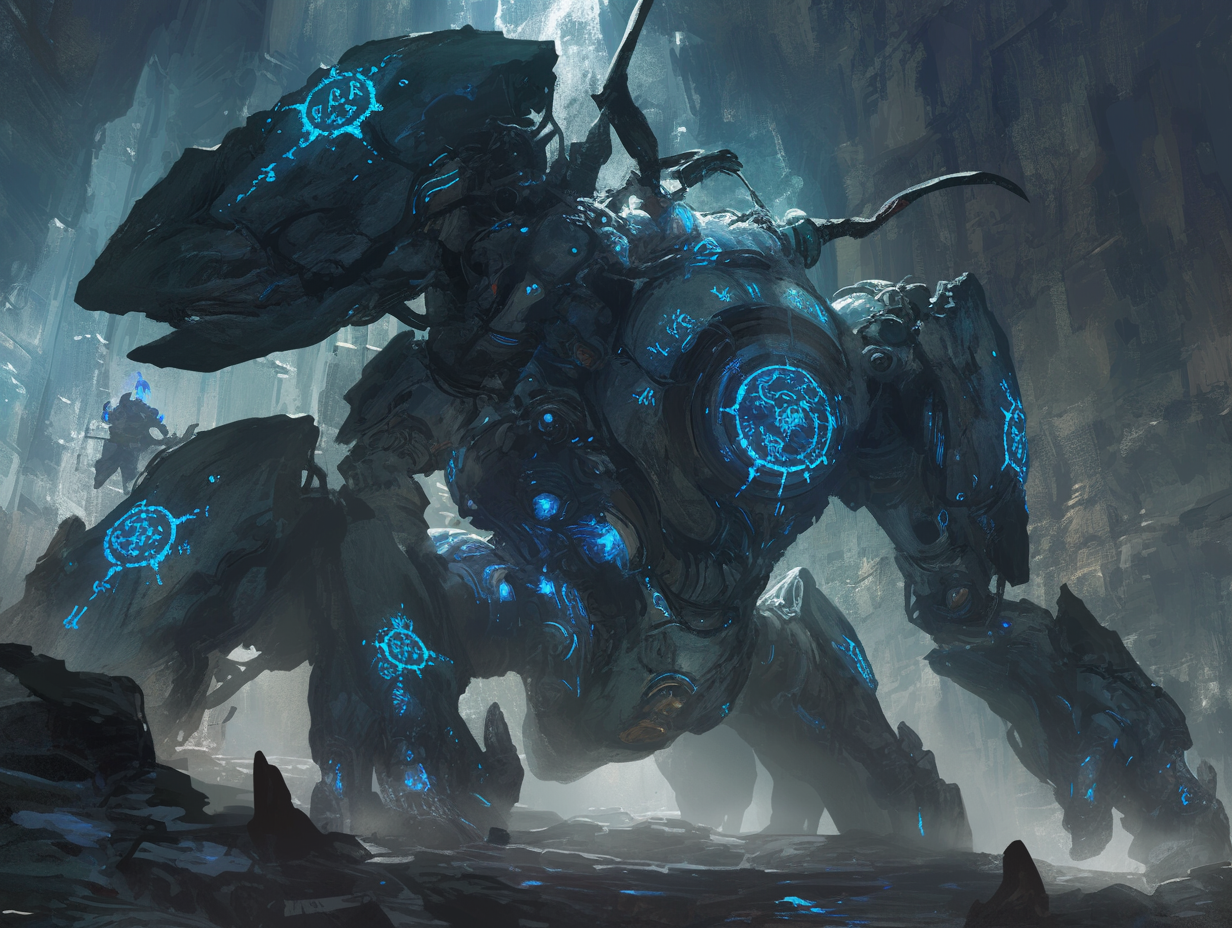
The shigai were monstrous entities that roamed the passages of the Corpse of Niseki. They were made of Nisekite, and made terrible noises as their organic bits gurgled and their stone limbs scraped against each other.
The shigai took on a myriad of forms, with each one different than the last. Early Nekrosakans called the shigai “lithic carnites” due to the similarities in their monstrous, unique sculpts.
It was unclear where shigai came from precisely, as well as how they were made. Nekrosakan miners that ventured into the Niseki Caverns to scavenge nisekite always saw these monsters emerging from the deepest, darkest, most unexplored recesses of The Corpse.
Link to original
Pherning Cao
The luxurious Pherning Cao was an opulent and excessively decorated palace built at the highest levels of Nekrosaka. The top of Pherning Cao extended outside to the surface, where the rarely seen majesty of the sun and moon could be gazed upon by the Bornu who lived there.
Access to Pherning Cao Palace was highly limited, with the Bornu rarely leaving it and Nekrosakan commoners being forbidden from entering it. Even Songkram diplomats who arrived to visit Nekrosaka rarely had the opportunity to see the interior of the palace, for if the Grand Lord learned of the prosperity being hogged by the Bornu, taxation would surely increase.
A dedicated wing of Pherning Cao served as a security checkpoint and the sole legitimate accessway to Nekrosaka from the surface (and vice versa).
Nekrosakan Factions
At the height of its power, Nekrosaka was far from a peaceful city. It was filled with various gangs and criminal organizations, and the civil war between the Kenha and Bornu Nakai never truly cooled.
The Bornu Family
 The Bornu were a clan of Isutan nobles who once served the Ganpoumi Fi and were awarded lordship over Nekrosaka when it was first established. Nekrosaka promised to be a bountilful land of precious stones and metal, and the Bornu would receive great prosperity from everything mined.
Following the Eastern Civil War, the Bornu eagerly pledged allegiance to the Songkram Empire, desperate to hold onto the riches their family had accumulated so far. After the Legerian War, the family once again shifted their priorities to ensure that their decadent lifestyles wouldn’t be disrupted.
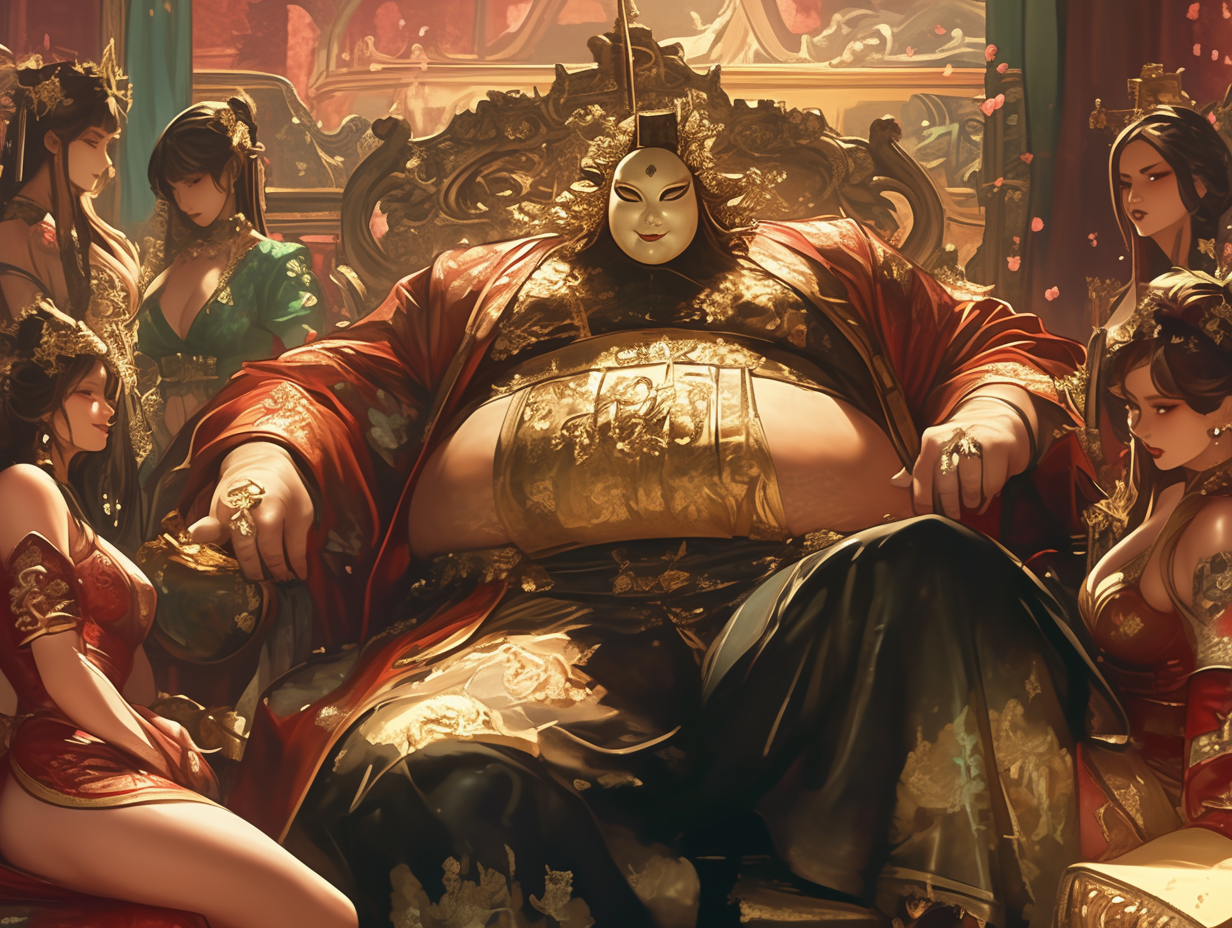
Greed and excessive indulgence, above all else, defined the Bornu. Every action they took was either to revel in their richness or defend their wealth. As ages passed, the Bornu became ugly, fat, and lazy. Each of their days consisted of a schedule jam-packed with orgies and feasting. They masked their horrid, incest-corrupted forms behind lavish costumes, masks, and jewelry. The nakai that served them were clad in bejeweled, gold-trimmed Starsteel, making them gleaming avatars of the Bornu’s avaricious ways as they walked Nekrosaka’s streets.
The Inbred Lineage
The Bornu were proud of their name and their wealth, and were determined to keep their so-called “honour” within the family. Like certain other ancient royal families across Legere, the Bornu engaged in incestuous relations to maintain their “purity”. However, the relentless depravity of the Bornu led to rapid expansion of their family, with each subsequent generation becoming more repulsive than the last.
To fuel their lifestyles, the Bornu claimed ownership over every precious mineral drawn from the earth by any Nekrosakan miner. Such resources were theirs to sell. Using these riches, the Bornu would purchase all sort of commodities from merchants traversing The Winding Strait. The Bornu also frequently had young Nekrosakan women abducted from their families to fuel their ravenous lust. Nekrosakans that took up the challenge of farming within the city’s limits also found that any decent-quality produce they managed to raise would be torn from their storehouses and brought straight to the Bornu’s tables.
Kenha Rebels
Kenha
The Kenha were founded by the most iron-willed of Ganpoumi Fi prisoners after they were sent to Nekrosaka by the Songkram at the tail end of the Eastern Civil War. While they were originally Ganpoumi Fi rebels who faced the cruel Songkram lords of Nekrosaka, they would eventually recast into a clan of loyal, duty-bound, Khatkir-inspired assassins dedicated to freeing the people of the city from the increasingly avaricious Bornu family.
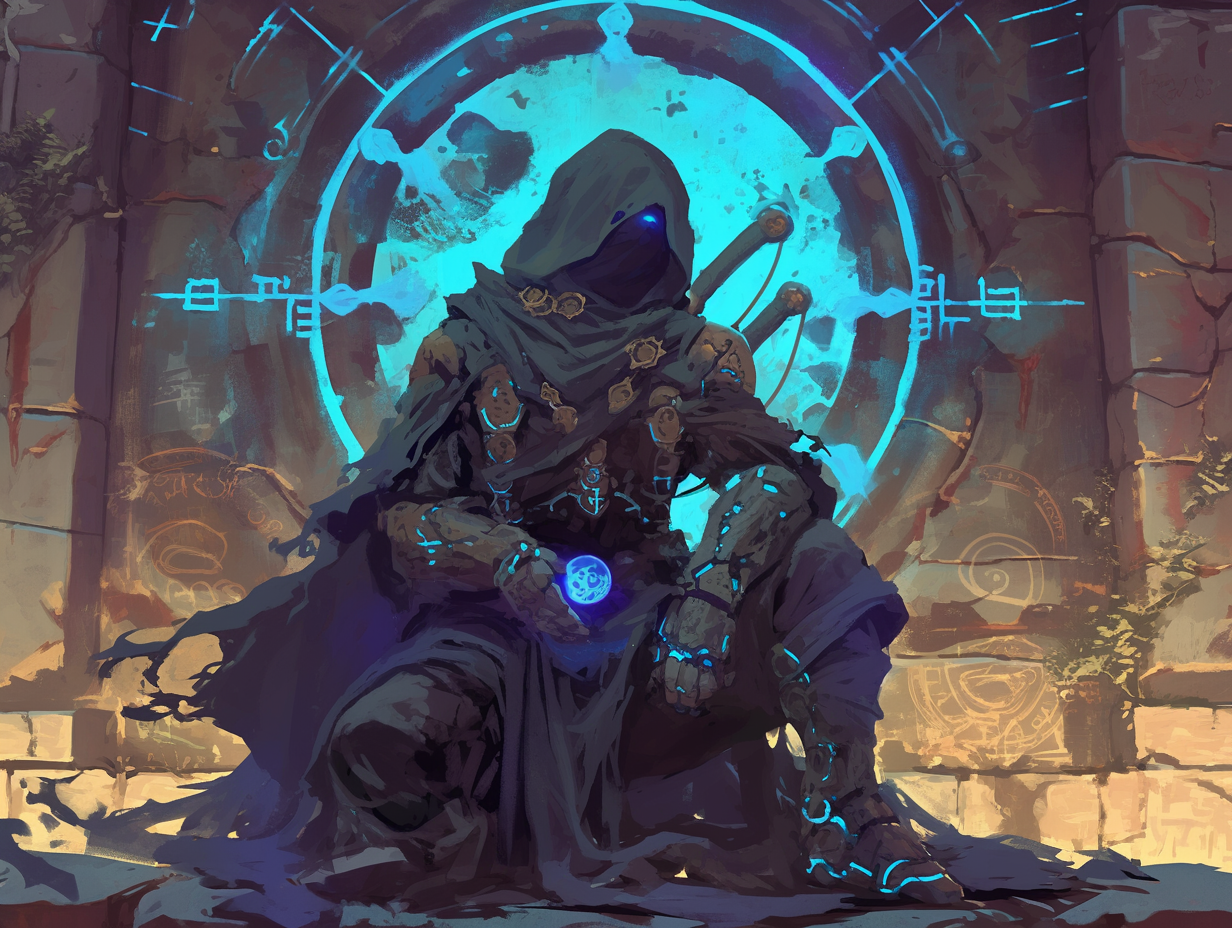
A kenha agent awaits mission data from his fellow operatives.History
The Kenha were originally led by the Ganpoumi Fi hero Ahagyu Kenha, and called themselves the Knives of Kenha. The name was shortened to just “Kenha” for the sake of simplicity after several years.
Following the discovery of Nisekite, the Kenha’s ranks became filled exclusively with Augmented (see below).
Humanity Abandoned
The purpose and central dogmas of the Kenha fundamentally shifted following the introduction of Nisekite-based technology into the landscape of Nekrosaka. The Kenha realized that the Bornu who oppressed the Nekrosakans couldn’t be defeated without drastic measures—Augmentation.
From the year 272 DHT onward, Kenha agents were mandated to undergo extensive stonemodding (in some cases, to the point where nothing was left of their original body save for the brain). As a part of this process, Kenha would have their memories wiped by undergoing surgery that removed portions of their brains and replaced them with lithonatomical disks. This drastic sacrifice of humanity was something that those radicalized enough to join the Kenha saw as necessary to not only defeat the Bornu, but also protect those from their previous life.
Body surrendered
I give up the transient
For people beloved.—The Kenha Creed*
Public Perception
While the Kenha are fully set on fighting for the people of Nekrosaka, the common Nekrosakans didn’t always see the Kenha in a positive light. Kenha operations that steered into open confrontation with Bornu Nakai often led to collateral damage. Suspicions against normal businesses led to public executions or arrests. Certain extreme Kenha viewed the sacrifice of a few innocent Nekrosakans as necessary for the greater good—a truly free Nekrosaka.
The anti-Augmented views of the widespread Tos Tohn movement also stood contrary to the Kenha. If those who sacrificed even a sliver of their natural form to lithonatomical replacement had sinned, then the heavily stonemodded Kenha were damned beyond salvation.
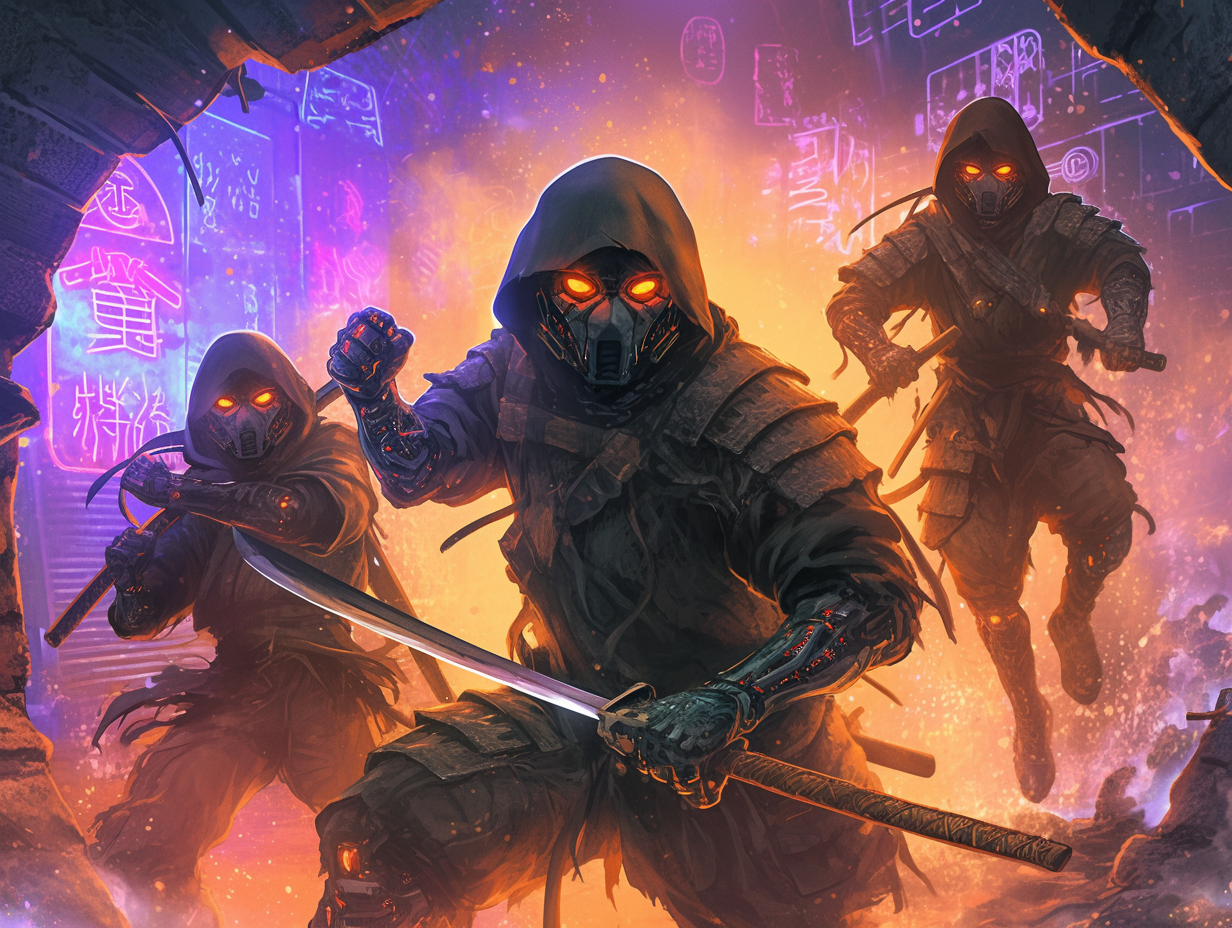
A trio of Kenha agents blow a hole in a prison record facility as a part of raid, the intent of which is to free an entire Nekrosakan district of their debts.Kenha Agents Outside of Nekrosaka
Although astronomically rare, Kenha agents would occasionally venture outside of the depths of Nekrosaka, smuggling aboard trade ships with the intent to secure supplies, allies, or other external resources for the benefit of the Kenha’s operations.
During the Songkram Empire’s sovereignty over Nekrosaka, Kenha typically kept their operations within the city to avoid drawing additional attention to themselves. However, once news that the Bornu were no longer backed by the Songkram leaked to the Kenha, they increased their presence across Legere in the hopes of making allies with other powers that could help them overthrow the gluttonous family.
In the late 330s, the Archangel’s Heroes would partner with the Kenha to finally defeat Nekrosaka’s Bornu oppressors.
Link to original
The Tos Tohn Fellowship
Tos Tohn
The Tos Tohn fellowship was a movement of people in Nekrosaka who believed that the grafting of Nisekite onto living flesh was a desecration of The Creator’s design. The Tos Tohn’s reception was mixed—many miners turned to Stonemodding to help them survive Nekrosaka’s mines. Additionally, many Nekrosakans saw anti-Augmented rhetoric as synonymous with pro-Bornu stances. This was mainly due to the Bornu’s constant trepidation of lithonatomical usage against themselves.
Like the followers of The Waymaker, the Tos Tohn fellowship was a Creator-worshipping religious organization.
Link to original
Local Culture
Nekrosaka was rife with crime and general lawlessness. The only thing that prevented the city from descending into anarchy were the lithonatomical cyborg monsters that emerged from the Corpse of Niseki, and the ever-growing quotas imposed by The Bornu Family.
Stonemodding
Stonemodding became widespread in Nekrosaka following its development after the discovery of Nisekite.
Nekrosakan Clans
Subfactions within Nekrosaka, known as clans, formed as a way for people to form trustworthy bonds. Without a clan at one’s back, one was susceptible to swindling, exploitative deals, and knives in the back. Clans ensured that miners and other workers wouldn’t be so easily cheated—a slight against a single member of a clan was a slight against them all.
There were hundreds of clans stuffed into Nekrosaka’s crowded limits, with the size and power of each varying. The most well-known clan was the Yubokumin.
Runecycling
Races
It wasn’t long after the runecycle’s invention when the many criminal organizations populating Nekrosaka’s depths started to use them as a form of entertainment. Large leagues of runecycle racers began to spring up, and runecycle stonemodders began to develop additional gadgets and improvements to make them more fit for high-speed, perilous racing. The more competitive runecycle races, which were not far off from Bloodsports, saw runecycles equipped with weapons and other equipment that focused on eliminating the competition rather than simply finishing first.
Link to original