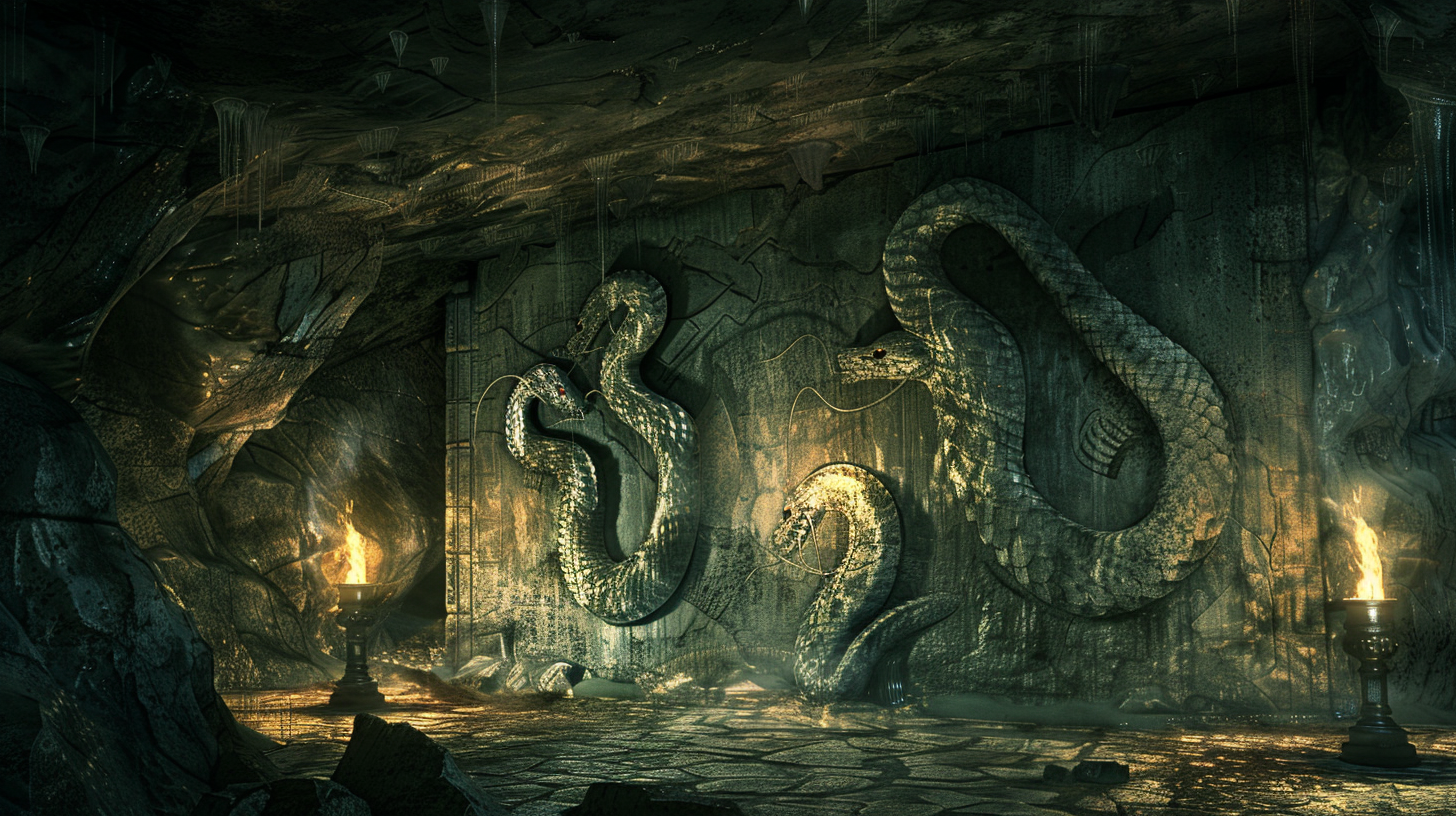
The Clergy of the Great Serpents was a priestly order of Naga that revered the Hydrisikk as gods (or more accurately, demi-gods) whose wills blessed or cursed the conquests and plans for prosperity that the naga would engage in.
Members of the clergy were primarily of Hysh’Hisal citizenship.
Common Myths and Legends
The naga believed in a sort of “primordial pantheon” of godlike figures that gave birth to their kind. These figures weren’t so much as actual deities, but some kind of more powerful, ascendant race that predated the modern naga kind. These mythical beings, named the Hyshsik, were said to have had two sets of offspring—the Three Firstborn, and their lesser children the His (or as they are often called, the naga).
The Three Firstborn
The Three Firstborn were, according to naga myths, the three giant species of serpents that dwelled in Legere: the Hydrisikk, the Akwasarr, and the Klo Ming.
Each of these creatures carried a third of the Hyshsik’s power, and each dominated the three corners of the world—earth, sea, and sky, respectively.
Legerian zoologists have acknowledged that these three species are very closely related, with each having three pairs of eyes and almost identical skeletons.
The Hyshsik were said to be mighty warriors and ingenious creators (by the naga’s standards, anyways), gifting naga with their language and access to their stockpiles of wealth hidden within the earth.
Naga Legends
The Hyshsik grew restless, concerned that their offspring were not perfect—unworthy of being their own flesh and blood. And so the great Hyshsik set out to elevate the mighty Hydrisikk and their lesser His to a state of power that would undeniably prove the strength of the Hyshsik that runs through their blood. To war the Hyshsik went, against their own offspring. They spilled the blood of their own children, creating a mighty scarlet river that ran through once silent caverns, a testament to those who were powerless and a shame upon the hallowed Hyshsik. For is it not the purpose of a new generation to surpass its predecessor?
The Hyshsik did not slaughter in vain, however—eventually, united by the coming eve of their extinction, the His and Hydrisikk banded together in a holy union that was powerful enough to shatter the armour and scales of the exalted Hyshsik. Seeing their children overcoming them, the Hyshsik died in peace, assured that their bloodline would reign long and with great dynamism.
It could be that the Hyshsik were originally a faction of upper-echelon naga that the main people rebelled against and overthrew thousands of years ago. The inferior bookkeeping and common transcendence to legend that naga historians were infamous for would then give rise to this tale.
Statues and other depictions of the Hyshsik portrayed them as tall, muscular saurian humanoids who lacked a tail. Their heads were similar to nagas’, but the snout was significantly shorter, and there was a third eye positioned in between the two normally-placed ones. Their left hand was a serpent’s head, but lacking eyes—only two large fangs and a forked tongue were present here. Their right hand was like that of a naga’s, often gripping a weapon or staff in a symbol of power.
Naga armour and some headdresses often displayed a third eye in the middle of the wearer’s forehead. This was to symbolize the three eyes found upon the Hyshsik, and was supposed to bring blessing and exalted strength upon the naga who wore it. This eye was often made of a gemstone that matched the intended wearer’s eyes, with the inside hollowed out and then inked black to create a “pupil”.
Link to original