The legacy of Phaendar Hironimus Draft was one of genius, leading to a meteoric rise to fame, fortune, and power, before an experimental catastrophe lead to a sudden retreat from society. Certainly, the founder of the Laboratory of Spatial Research and one of the six original founders of Destral had a reputation that was larger than life.
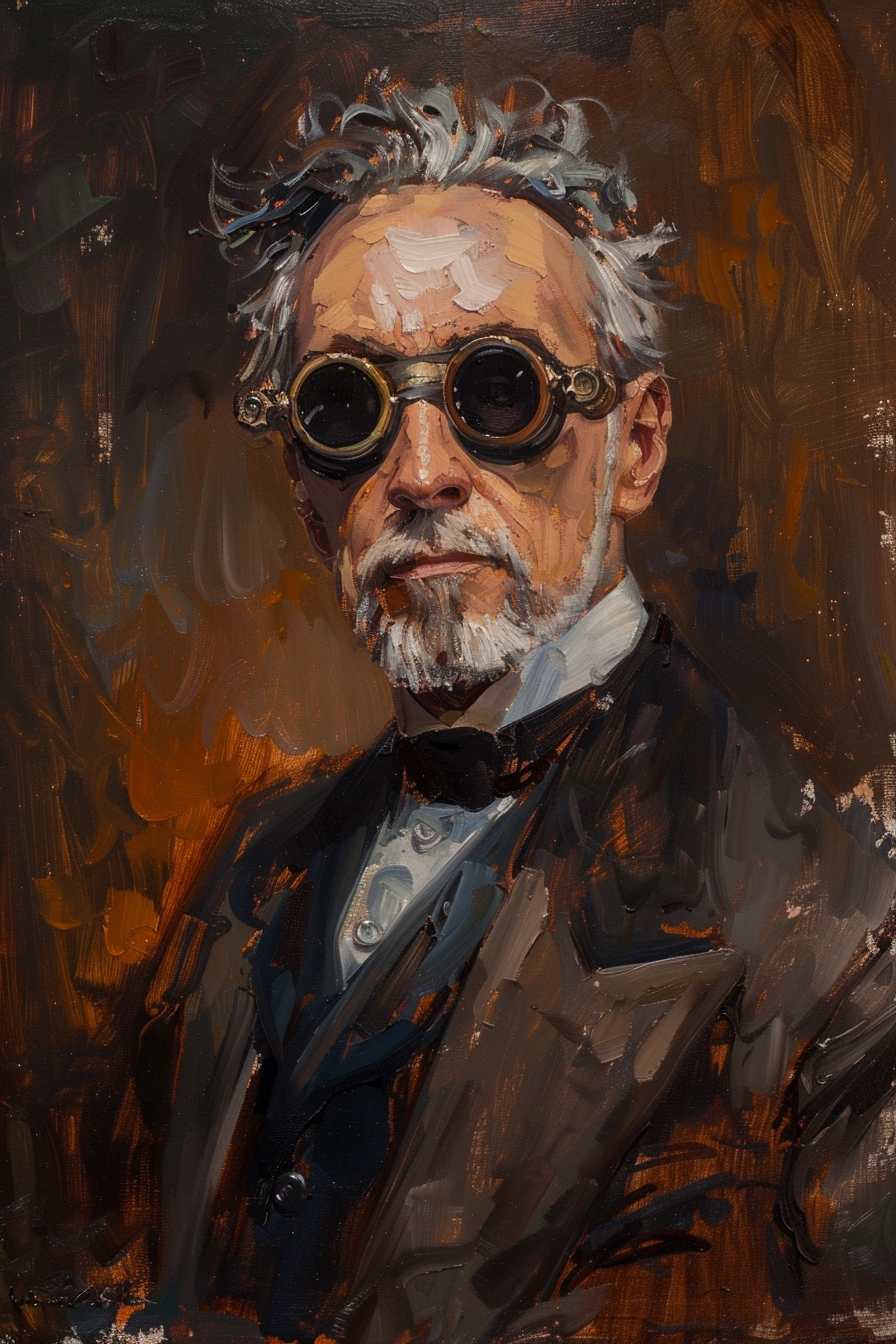
An oil painting of Phaendar, displayed prominently in the halls of his laboratory.
Early Life
Phaendar Hironimus Draft was born in Phovezila to a middle-income family with a history of spellcraft. He had the privilege of receiving an education, and through it developed an appreciation for the philosophy of studying magic. He had a great deal of difficulty and frustration in actually practicing any arcane paths. Later, he became deeply fascinated by The Ancients, and the history of their destruction in the Ancient Wars several decades prior.
In his youth, Phaendar travelled to the mass burial site of these Ancients, curious as to what knowledge could be gleaned. To his surprise, he learned that he was not the only one with such a curiosity. Instead, he was among a group of pioneers in what soon became a gold rush of scientific progress. A small town of like-minded researchers had already settled in the area, churning through the heap of scrap for valuable items.
After some study, Phaendar excelled in tinkering with the technology of the ancients. This earned him a seat at the table with the fledgling Destral’s smartest minds, and in short time, a position of power.
Career
Early Career
Phaendar, enraptured by the fact that The Ancients fell from the skies, began by studying the ancient’s methods of locomotion and communication. He was fascinated by what means these machines appeared, where they came from, and how they had the ability to coordinate strategically across Legere. In his research, Phaendar was the first to discover the series of sensors the Ancients used to communicate with each other across great distances, and used that as a way to speak with another person from a distance. Of course, such a feat was being performed by practitioners of certain Arcane Paths already, but this was an extraordinary accomplishment for non-magic practitioners.
Founding of Destral
Soon, Phaendar made a name for himself as a scientific wunderkind. In doing so, he found himself in the company of the brightest scientists and engineers in his field. In time, pressure came for the growing town to form a collective identity and establish itself as a unique city-state. The people sought to elect their smartest minds as leaders, and Phaendar was on the shortlist. He succeeded in securing the approval of the people, and Phaendar Hironimus Draft signed the documents to establish Destral alongside Li Huo, Azalea Abernathy, Caroline Constella, Cyrus Isaac Vandervitch III, and Radium Josiah Radcliff as Founder.
Phaendar established the Laboratory of Spatial Research to continue his studies and develop a cohort of equally-focused students. Incredible scientific progress came as fruits of this establishment, and booming economic progress followed.
Research
Through the Laboratory of Spatial Research, Phaendar lead and oversaw the research of long-range communication, non-euclidean spaces, pocket dimensions, astrological bodies, and even demiplanes. As Phaendar’s team grew in size, he developed the habit of leaving projects half-finished in pursuit of his curiosity; leaving the team on their own to get the research across the finish line. A significant focus of the laboratory was on understanding the space beyond Legere. While Phaendar often delegated this research to prioritize the practical, he always took a near-obsessives focus on interesting findings in this field. Findings about the worlds beyond Legere, to what extent they existed at all, was the stuff of daydreams for Phaendar.
Phaendar was personally responsible for the development of the first stable pocket dimension created without the use of Abjurmancy. This device, in the form factor of a small box, was capable of storing personal belongings for retrieval later.
The continuation of this line of research lead to the development of demiplanes, which Phaendar lead the study of. This involved holding open a non-euclidian area in space for a prolonged period of time, which proved very strenuous. Doing so revealed a completely grey space, dubbed “The Empty Plane”, in which a traversable demiplane can be formed.
In a close call that nearly cost a researcher his life, it was discovered that openings in the empty plane contain no air. Should a person be trapped inside with no open doorway, they would quickly suffocate. As such, research into synthesizing breathable air for these spaces was performed and achieved.
Another near-miss almost resulted in the crushing of several researchers. Maintaining demiplanes in the Empty Plane requires carefully fine-tuned measurements; and being off of equilibrium will result in a gradual drift from stability, resulting in an avalanche of space disruption. What this practically meant for the researchers was observing an entire corner of the room collapse, and the room suddenly went from a rectangular prism to a wedge! A researcher was thrown from his location, and they all made a hasty retreat. This incident has lead to the theory that the lowest energy state of the Empty Plane is, well, empty. It would shrink to the tightest space possible around the objects it contains, and, ideally, to no space at all.
These workplace incidents, and several others like them in other areas of research, have been raised. However, Phaendar, as well as the other laboratory founders, did their best to stifle conversation about it.
A major focus of research within the laboratory, towards the end of Phaendar’s career, was on the study of teleportation. Teleportation was only achievable by some of Legere’s most powerful mages; but Phaendar strongly believed that the Empty Plane held the key to making it accessible to the most common of people. If two doorways could open up to the same space within the empty plane, someone would only have to walk from one doorway to the next to travel a greater distance on Legere. However, this came with significant logistical and safety hazards, particularly around fine-tuned coordinates within the empty plane and concerns around stability. At the time of Phaendar’s death, this dream had not yet been realized. Sadly, research on the topic had several setbacks after his death.
Personal Endeavors
Phaendar had several personal projects, which he kept very secretive; except for to a select few. In the second half of his career, these projects took so much of his time that he would disappear for weeks on end, neglecting many of his duties.
Clockwork Beacons - Puzzle Amulets
Read more here: Clockwork Puzzle Amulets
Clockwork Puzzle Amulets
Phaendar had the foresight to recognize the need for a successor as the head of his laboratory. He was protective of this title though, unwilling to hand it to just anyone; even the most promising students under his purview. He was committed to Destral’s vision of being lead only by the best and brightest, and the likely case was that this person was yet unknown.
Phaendar devised a test that would bring only the most inquisitive, most brilliant, and perhaps even the most fateful protégés to him. He crafted three unique clockwork puzzles, in the form-factor of amulets or pocket watches, and distributed them across Legere. Each of these puzzles had different solutions, but they all had similar features.
- They were resistant to magic that could decipher their solution, except for some of the most potent Abjurmancy. Spellcasters were not ideal candidates.
- They were solved by carefully manipulating fine internal components such as gears, switches, and springs, in the correct order.
- Certain stages of the solution would rearrange themselves upon incorrect inputs, thus changing the correct solution.
- Each amulet followed the same general progression of difficulty, which also changed the form-factor and usefulness of the amulet:
- The default state of the puzzle was a timepiece with an intricate assortment of gears and springs.
- Upon basic tinkering, a device will play Phaendar’s voice, congratulating the tinkerer for finding this device, and encouraging them to solve the deeper puzzle built into it.
- Upon the completion of a few basic puzzles, the amulet would eject a Destrian coin. Re-inputting the solution for this step at any point would actually eject another coin, up to 30 times total. This little reward was intended to distract lesser tinkerers, who would be unable to see past the treasure to the deeper rewards below.
- A series of more complex puzzles followed. Upon completion, a hard-light projection of the mysterious Phaendar would appear, congratulating the tinkerer on a well-earned success! He would instruct the tinkerer to come speak to him in Destral; a meeting he was greatly looking forward to. Then, the amulet would project a blue hard-light stylized letter P, pointing in the direction of Destral. In fact, it pointed directly to Phaendar’s tower near the center of the city.
- A final, brutally difficult series of puzzles became available, which could be overlooked by the congratulations message. These puzzles gradually expand the amulet into a mess of mechanisms and concentric rings, triple the original size. The last puzzle of this series caused a series of concentric rings to spin to life, before blasting a flash of light! When the light cleared the tinkerer would find himself / herself in a lounge within Phaendar’s Planar Tower!
Finders of the Amulets
The three amulets Phaendar released into Legere passed hands several times before reaching promising candidates. They were passed between trinket traders, pawn shop customers, and curious friends, and were not investigated by most owners. Some tinkerers did complete a few levels of puzzles, before passing it over to someone they hoped could solve it.
The first amulet to be solved eventually made its way through the Kaktis Desert to Siman, where it passed hands between the city’s inquisitive magi. It was solved by Belial Ben Hasid, who followed Phaendar’s call to Destral and became his first apprentice.
The second amulet eventually collected dust in a pawn shop in Corgath, before being picked up by Theodore Perry. Theo was able to solve it, and brought himself to Phaendar’s doorstep nearly a decade after Belial, in 275. The fate of the third and final amulet is yet unknown, and no one brought it to Phaendar before he died. Should someone solve it after his passing, they would be directed to the Laboratory of Spacial Research, and his successor.
Link to original
Planar Tower
Read more here: Phaendar's Planar Tower
Phaendar's Planar Tower
One of Destral’s greatest scientific creations, a technological marvel that could have easily been called a wonder of the world, was kept a secret. Phaendar Hironimus Draft created for himself a home in The Empty Plane; a sanctum where he could live and work undisturbed. This Planar Tower was the culmination, and untimely conclusion, of his life’s work.
At first, Phaendar wanted to leverage his discovery of stable demiplanes to create a safehouse. He made for himself a room that he could escape to; in the event of angered political rivals or another global supernatural catastrophe. As his research continued, he learned how to connect multiple spaces within the Empty Plane. Before long, he had built a network of connected rooms. The purpose of this sanctum quickly became a place for secretive laboratories, to keep controversial projects out of the eyes of others.
Phaendar did not have a limit to his plans for expansion, and so his work was never finished, but it did conclude. In its final state, Phaendar called his home in the Empty Plane his Planar Tower, though it did not resemble a traditional wizard’s tower. Instead, rooms were arranged in the form of concentric rings; which Phaendar hypothesized all things behaved as, from the heavenly bodies to the smallest particles.
Each floor had eight rooms connected to each other as a ring. Floors were accessible to each other only by elevators. However, the layout of the tower could be shifted at certain control rooms, causing floors to rotate. This would make it such that the elevators, which were fixed in place, would connect different rooms than they did before the shift; opening pathways and hidden entrances.
Each ring was given an alphabetic indicator (A-E is as far as he finished), and each room was numbered 1-8. The exceptions were Ring A (which only had two rooms) and Z1, the Nucleus (a grand mechanism at the center of this tower). Each ring required a mechanism, called a Ring-Stabilization Crystal, which balanced the ring and its rotation. If they failed to function, rings could experience unexpected shifts, or even their entire collapse. Using these ring-stabilization crystals, Phaendar also could rotate the entire structure at breakneck speeds, causing a time dilation. He intended to use this to give himself additional working time, or to speed past events he would rather avoid.
A Catastrophic Experiment
Miscalculated Endeavours
Phaendar hypothesized that the Empty Plane could be used as a method of teleportation. If a space in the plane could be entered from one location and exited to another location, a shortcut between the locations was made. His tower established that this was possible, as long as finely-tuned equipment was set-up in both Legere and the Empty Plane. The difficulty of achieving this, however, prohibited this method from being used in other circumstances for most of Phaendar’s life.
Phaendar left bridging the logistical and economic gaps to his teams, so that he could focus on the next endeavor. He desperately wanted to achieve on-demand teleportation from one location to another, without setting up an anchor at the destination. One of Phaendar’s earliest endeavors was the search for the source of The Ancients; and so, in his hubris, that’s where he set his first trial destination. Years of dedicated research and study gave him sufficient certainty that he knew their source.
In a dedicated laboratory, room B8, Phaendar created a doorway. With precise coordinates and fine-tuned instruments, he believed he could open a portal to any location he pleased. Phaendar recruited his new protégé, Theodore Perry, to help him operate his experiment. He sold him on the purpose of the experiment, but did not disclose to him the intended destination.
Fatal Errors
On 9/5/275 DHT, Theodore and Phaendar began to conduct their experiment.
A critical observer should note that Theodore was likely not fit for duty at this time, as he had an altercation with Silvaar Darkthorn the day prior.
After reviewing their calculations, the pair each manned a control panel, located at the far end of the room. In tandem, they entered the coordinates and tuned instruments according to their calculations, and validated their inputs. The two then activated the machine, in stages, until the startup phase was complete. Then, successful so far, they engaged the portal.
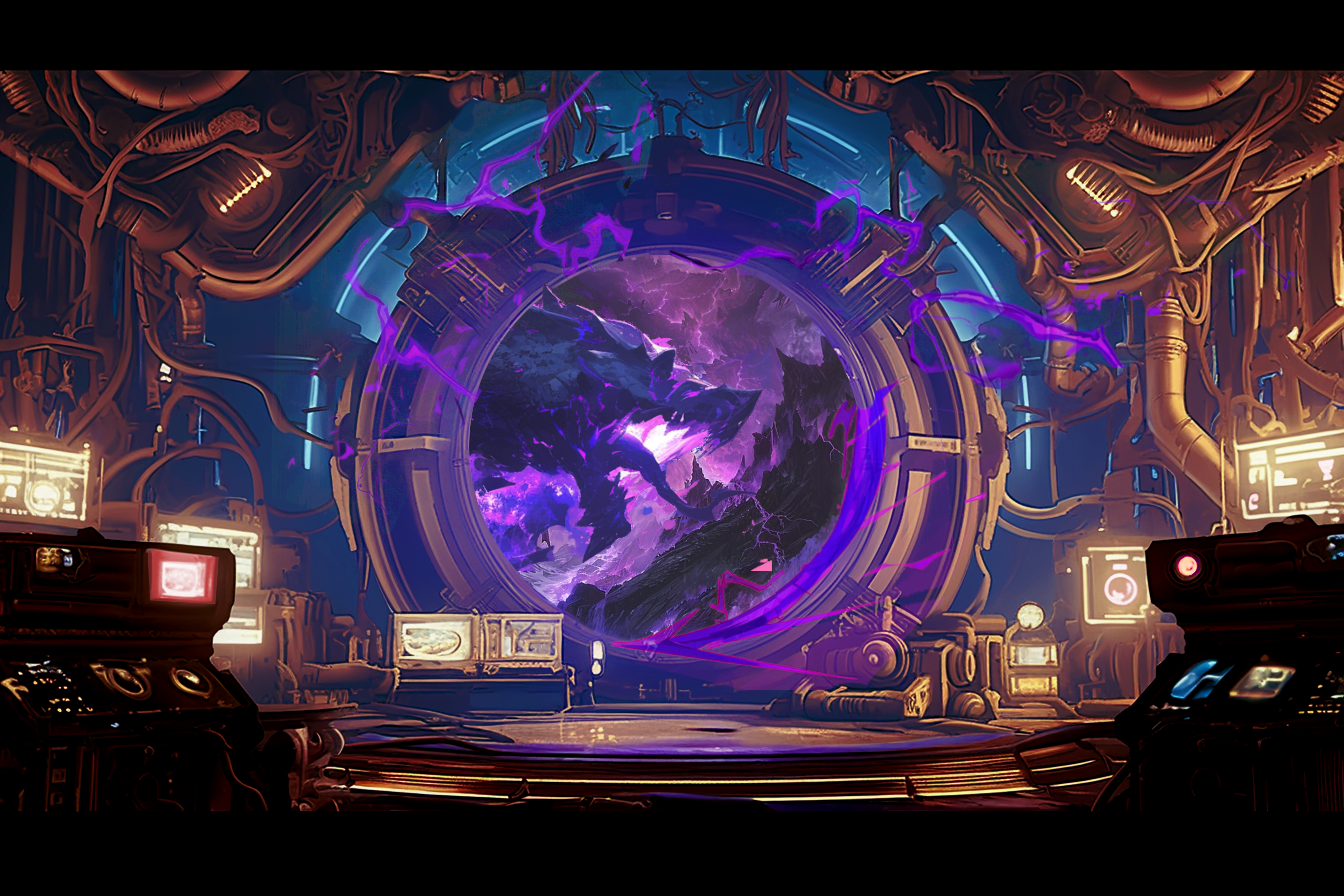
The rings of the portal spun to life, and an indigo light illuminated the portal doorway. The vortex of energy stabilized to reveal the destination that the carefully chosen coordinates lead to. But to Theo’s surprise and Phaendar’s horror, the doorway opened to the inky-black emptiness of space. Grey rubble, with hints of green and orange, drifted lifelessly.
At seeing this, I shouted at Theodore, needing him to confirm the coordinates. To my bewilderment, the planet I had seen in my dream was absent... or rather, destroyed...
The emptiness sucked the air out of the room, and the portal mechanisms creaked and groaned under the pressure differential. Alarms sounded from the control panels as the system equilibrium began to slip. Then with a blinding flash of light, the other side of the doorway changed.
Suddenly, the two scientists gazed in terror at a blasted hellscape with a violet sky and unfathomable landforms. In the same instant, a blast of energy ripped through the room with such force that conduit and cabling were vaporized, instruments were obliterated, and the very rings of the tower itself fell out of alignment. The energy arced through the control panels, up the arms of both men, and threw them backwards against the walls. They were both left with severe radiation burns: char-blackened skin cracked with fissures radiating white light. Theo lost his left arm from the damage, and Phaendar was irreparably scarred on his entire right side.
I barked orders at Theodore for him to turn it off, but we were both too injured, and the control panels were totally unresponsive. We had to flee. But my gaze was transfixed on that alien world, and its profanities were seared into my retinas. I saw bizarre creatures, unspeakable monsters, rush towards us... and at that moment, Theodore pulled me away.
With a doorway to The Void open, and the scientists unable to close it, hordes of Voidspawn began to rush out. The two abandoned their machine, in order to escape through the labyrinthian sanctum of the founder. Upon escaping The Empty Plane, Phaendar hired Theodore and his companions to save his home. The mission: Clear out the monsters, close the portal, and bring as many rooms back online as possible.
Aftermath
The team encountered the rooms outlined below, and in the end were successful. The entrance to The Void was closed, but irreparably weakened. This weakness in time would prove catastrophic. Theo would make the most of becoming an amputee, but Phaendar struggled through his injuries for the rest of his life (which, alas, was not much longer).
Notable Rooms
At the end of his work on the tower, Phaendar had completed rings A-D (27 rooms), and was working on the completion of ring E. The following is a list of the rooms in Phaendar’s tower, as well as their purposes and fates.
Z1 - The Nucleus
Ring A
A1 - Main Control Center
A2 - Nucleus Vault
Ring B
B1 - Power Indicator Sculpture
B2 - Antechamber
B3 - Control Room
Each ring contained identical control rooms, which were used to rotate the rings of the tower. Each control room was a small but ornate space; circular rooms with white marble floors and walls, with a domed marble ceiling. The walls were decorated with complex patterns made of gold and copper inlays. In the center of each control room was a gyroscopic model of the tower, with glowing letters indicating the rooms of each ring. Approaching the model caused it to slow down, inviting the user to manipulate its rings.
After the accident, several rooms were no longer lit up on the rings. These rooms were offline and unnavigable by elevators. Instead, a skilled tinkerer had to travel to that room and get it back online.
B4 - Bedroom
B5 - Exercise Room and Squash Court
B6 - Dining Room
B7 - Kitchen
B8 - Portal Experiment
Ring C
C1 - Recursion Laboratory
Here, Phaendar made ground breaking progress on research about the The Grey Plane: pocket dimensions, demiplanes, and teleportation. Several work-in-progress machines were being built here.
The tower’s accidents caused all of the devices to malfunction catastrophically, causing the room to become warped and twisted with extradimensional errors. The room’s floors and ceilings mirrored each other in a dizzying recursion. A prototype portal, like the one used to enter and exit the laboratory, was glitching between eight different locations. A staircase in the corner of the room, which previously only reached a second-floor loft of bookshelves, suddenly caused the user to grow in size when walking upwards, and shrink in size when walking down! On top of these, a silver sphere constantly transformed into other objects; and a chest now contained another chest inside, which held another chest, and another, ad infinitum.
Two terrifying creatures also now made this room home, but it is unclear if they were Voidspawn or of some other origin. One was a recursive centaur: which of course was a centaur with the body of a horse and the torso of a recursive centaur, which had the torso of a recursive centaur, which had the torso of a recursive centaur… The other was a lanky bipedal humanoid, whos face was a triangular fractal. Looking at either of these creatures for too long would drive a person mad.
C2 - Arcane Armory
This room was isolated from the rest of its ring, only accessible by an elevator. The door was guarded by a strong arcane lock. Behind this door was a long vault, full of treasures. The room held fine art, prototype inventions, rare weapons, and two huge ornate cannons. These cannons were rare artifacts; from the first line of Gun Guard prototypes, given to Phaendar as a gift from Li Huo. They also were constantly armed and ready to fire if certain pressure plates were tripped by intruders.
This room was untouched by the accident.
C3 - Control Room
This control room was the same as the others on each floor. See B3 for more information.
C4 - Battery Reserve
C5 - Amulet Welcome Chamber and Meeting Room
C6 - Guest Workshop
C7 - Observatory
C8 - Library
Ring D
D1 - Antechamber
This antechamber was a welcome and waiting area for anyone entering from Legere into the D ring. After entering through the portal of spinning concentric brass rings, one found themselves standing in a large room with decorated marble floors and light stone walls. The floors were decorated with violet patterns of concentric rings. Four pillars supported an arched ceiling.
When a visitor would enter, the room would transform with furniture appearing from the floor. Bookshelves arose from the floor, shifting to curate the collection to the visitor’s assumed preferences. Sitting areas for waiting guests to patiently peruse the volumes accompanied them. A small platter on rails would descend from the roof nearby to offer visitors a glass of water.
Powering the portal was a large glowing purple crystal, flanked by two statues. These ornate marble and copper statues were of non-descript Destrian-looking figures: one looking intently at an astrolabe, and the other looking at the heavens through a telescope.
This room was unperturbed during the accident.
D2 - Plumbing and Chemical Storage
This room was used as storage of hazardous chemicals needed for various experiments. The room is a mess of piping, with lines running criss-cross through the entire place. In the centre of the room were 4 large glass chambers, holding vats of often-needed chemicals.
After the accident, the glass vats broke open, and several chemical lines burst. The floor was two-feet deep in acid, which was supposed to empty through a clogged floor drain. Enchanted acid, in the form of bats and amorphous blobs, attacked intruders!
D3 - Clockwork Ballroom
This ballroom was meant to entertain and amaze guests of Phaendar. Clockwork mechanisms rearranged furniture, floors, walls, and chandeliers as a flashy show of technical hospitality. Unfortunately, after the accident, the mechanisms became bent and misaligned. When activated again, the moving floors and walls acted more like a terrifying beartrap.
D4 - Mushroom Grotto
As a man curious about everything, Phaendar created this room to grow rare fungi with rare properties. This room took the form of a narrow and rocky cave tunnel. The walls were lined with luminescent mushrooms of various colours and sizes. At the back of the room was a wooden planter box, which became overgrown.
To run this project, Phaendar hired two Mylembo, Gorb and Borb as fungal gardeners. They were friendly folk who enjoyed their work, even though they were largely forgotten about by Phaendar. They never travelled to other rooms of the house, except for their path in and out, and were totally unaware of the accident until the Heroes of Nokkville escorted them out.
D5 - Sculptoris Laboratory
This room was disconnected from its adjacent rooms, only accessible by an elevator. The entrance was a sealed bulkhead, which warned personnel against entry if hazards were detected inside. This abundance of caution was because Phaendar was experimenting with one of Legere’s most dangerous substances, Sculptoris.
With a sample acquired by unknown and unsavoury methods, Phaendar was growing a colony of sculptoris. His goal was to create a clone of himself, and transfer his consciousness into it, to prolong his life indefinitely. His body was growing old, he felt unfinished in his life goals, and he was spurred on by his lack of a successor after his broken relationship with Belial.
The tower’s accident severely disrupted this room. The cloning experiments failed, causing the four candidates to become horrifying manikins in Phaendar’s image. The colony of sculptoris broke free and became a Carnite, which spewed a dense red fog throughout the room.
When the Heroes of Nokkville came to this room, they proceeded despite the bulkhead’s warning of
Threat Level: High. A harrowing battle ensued, and Firen purged the laboratory with fire. This put an end to Phaendar’s plans for immortality; but Theo did smuggle out a vial of sculptoris.D6 - Tetragrammaton Study
This room was designed to be a sitting lounge and temporary study for guests; furnished with three simple chairs, a circular coffee table, and a few decorative plants. However, Belial modified this room to hide his secretive research. By placing the chairs around the coffee table in a certain configuration, clockwork mechanisms transformed the room. The coffee table and chairs flip into the floor, and an ornate desk, comfortable chair, and several drawers appear.
When Belial parted ways with Phaendar, he left several journals of notes, drawings, and other paperwork. These drawings repeatedly referenced triangles and pyramids, and the notes devolve in terms of clean handwriting and coherent thought. In his drawers were several models of the Tetragrammaton, including clay and wooden miniatures of the artifact, which are known to be found in ruins of the Kaktis Desert.
This room was unmodified by the accident, except for throwing the clockwork mechanisms out of calibration; causing them to move with erratic force.
D7 - Control Room
This control room was the same as the others on each floor. See B3 for more information.
D8 - The Divine Machine
This strange room was only partially constructed, with sheets and bars of metal just barely holding together. Where the construction ends, the room transitions to stone-brick walls and floors, of seemingly ancient design. The end of the room is blocked off by a mysterious wall of golden light; far more radiant than Destrian hard-light. Looking closely at the wall reveals characters of the tongues of angels written inside. Touching the wall with items made of Demonium causes sparks to fly.
Against the wall of the room is a notebook, and the open page reads:
Phaendar's Notebook
While creating the final room of Ring D, I overlapped with a pre-existing structure. Though every pocket-dimension and demi-plane finds its roots in the empty plane, intersecting one is highly unlikely; and no such rooms appeared in my surveys or calculations. In my curiosity, I thought prudent to investigate the room and discuss with the owner the proper path forward. However, upon entering this room I discovered it was more curious than I ever expected. Not only was it abandoned, but its architecture is unlike anything I’ve ever seen. It likely predates the Demon Wars, because I know of no culture alive or dead with such sophistication. What lies behind this gate is unfathomable, and I dare not write it down. Within lies knowledge beyond comprehension, and insight greater than words. I fear what Belial will do if he learns I did not trust him, in his rashness, to come with me.
I’ve decided to assign D8 as a permanent attachment to this ruin; I’ll have to find a place for my garden elsewhere.Phaendar is the only one, by written knowledge at least, to have gone beyond this door. Whatever was behind it was of great importance to the angels, and his encounter with it changed him forever.
Link to original

Research on The Source of The Ancients
Phaendar spent extensive work on understanding the source of The Ancients. The mystery of their creation remains unknown to most people; and among those who haven’t spoken to a supernatural being, Phaendar discovered the most. The discovery of text written on the components of Ancients lead Phaendar and his team on a race to decode it. The language and alphabet were totally foreign to Legere. A breakthrough came when his apprentice, Belial Ben Hasid, drew similarities to archaic texts found in his home region of the Kaktis desert, which were historically attributed to the Angels. Phaendar and Belial together used this discovery to translate key texts, finding them to be part information such as hard-light emitor, heat sensor, and the like. Though these translations would seem minor, they allowed other research teams to make significant breakthroughs in certain fields.
Phaendar later used this research to acquire knowledge from an encounter in the empty plane, and Belial later used this research to hunt down an ancient relic. These two endeavours are what caused the pair to part ways.
Shortly after these breakthroughs, Phaendar began to have reoccurring dreams:
Phaendar describing his dream to Archibald, his trusted butler.
I keep having the same dream. I see white and green eggs fall from the sky, crash-landing across Legere. This is clearly the Heaven Egg Rain. But the dream pans out into the heavens, from where these eggs are coming from! I see a celestial body, a planet (I presume) which glows a vibrant green, as bright as a star. I have searched since, and have been entirely unable to find a body like this in our night sky. In my dream, I see the vibrant glow of the planet dim a little, as its pale surface darkens with black and purple… an ominous portent. I always feel like I enter a cold sweat during this part of the dream. During this, the frequency with which the eggs leave the planet accelerates, more and more begin to depart. They leave at a frantic pace now. And then I see something different leave the planet - not egg shaped, but a man. I see the man fall to Legere like a comet, faster than the eggs, and crash land in a field. A beacon of emerald light emanates where he lands. I can’t help but feel like the field is familiar, like near home, but I’m sure that’s just my dream-state interpolating. After this, I wake up. I really cannot make heads or tails of this, Archibald. This man does not match the description of an angel, and I find no records of someone accompanying the Heaven Egg Rain. Perhaps it’s yet to happen? I wonder if I would be able to travel to that place, my friend, and perhaps uncover the meaning of my dream there…
Only a select few friends and colleagues knew that these dreams resulted in the catastrophic experiment that stole Phaendar’s health. And only Phaendar himself, and perhaps the angels, knows how these dreams began.
Relationships with Colleagues
It is important to note that the Founders of Destral were chosen because they demonstrated scientific brilliance, and not because they were charismatic, excellent speakers, or even likeable. As such, their personalities, hubris, and social awkwardness’s caused clashes between one another. Phaendar was also roughly 10 years the senior of most of the founders, which proved to be a generational divide.
Most notably, Phaendar had a poor relationship with Cyrus Isaac Vandervitch III. Cyrus was known for being harsh and vindictive, and several instances of Destrian political disagreements between he and Phaendar became personal when they aught not needed to be. Phaendar’s lofty visions were impractical and unfocused according to Cyrus, who often blocked their progress; for which Phaendar resented him and considered him narrow-minded.
Phaendar’s relationships with the other founders were more or less neutral, though strained particularly towards the end of his life. Azalea Abernathy, however, mostly through her own effort, maintained a strong and positive relationship with Phaendar until his death. Azalea was the most gentle of the founders, and Phaendar’s constant quiet introspection was appreciated, and vice versa. When Phaendar was severely injured in his failed portal experiment, Azalea and her team provided the best care accessible to him during the final chapter of his life.
Phaendar was supported by his trusted butler, Archibald. Archibald maintained the house, scheduled meetings and events, parlayed in politics, and was Phaendar’s closest friend. Unknown to most, Archibald was also a very skilled swordsman, and quietly stood guard if a trespasser ever came to the front door.
In his mid-career, Phaendar felt the need to train a successor, and recruited using three special amulets. His first protégée was Belial Ben Hasid. He and Belial built a promising partnership, bonding over mutual curiosities in the supernatural. Belial was very focused on the Angels, and Phaendar supported his research into their connections with the Ancients. However, in their fifth and final year of working together, Phaendar became concerned that Belial was becoming obsessed. It began as a distraction from other promising areas of research, but grew into a constant and compulsive focus. Belial became obsessed with a relic from the deserts near his home of Siman, to the point of being violent if interrupted. A final confrontation and fight resulted in Phaendar barring Belial from his laboratory and personal studies, sending him on his way to find this treasure alone.
Later in his life, a second candidate appeared, by the name of Theodore Perry. Phaendar was excited for a new opportunity and thrilled by the promise he showed, and welcomed Theo into his laboratory. Their partnership was tested but strengthened amidst the failure of the fateful portal experiment. After this trial, the two built a stronger relationship, to the point of Theo succeeding Phaendar as head of the The Laboratory of Spatial Research.