The primary world in this universe’s narrative was the higher dimension named Legere. Inside this dimension, the main planet it is known for is also referred to as Legere. Legere was a bicontinental planet with unique features like naturally occurring magical currents that dictated fantastical climates and other things.
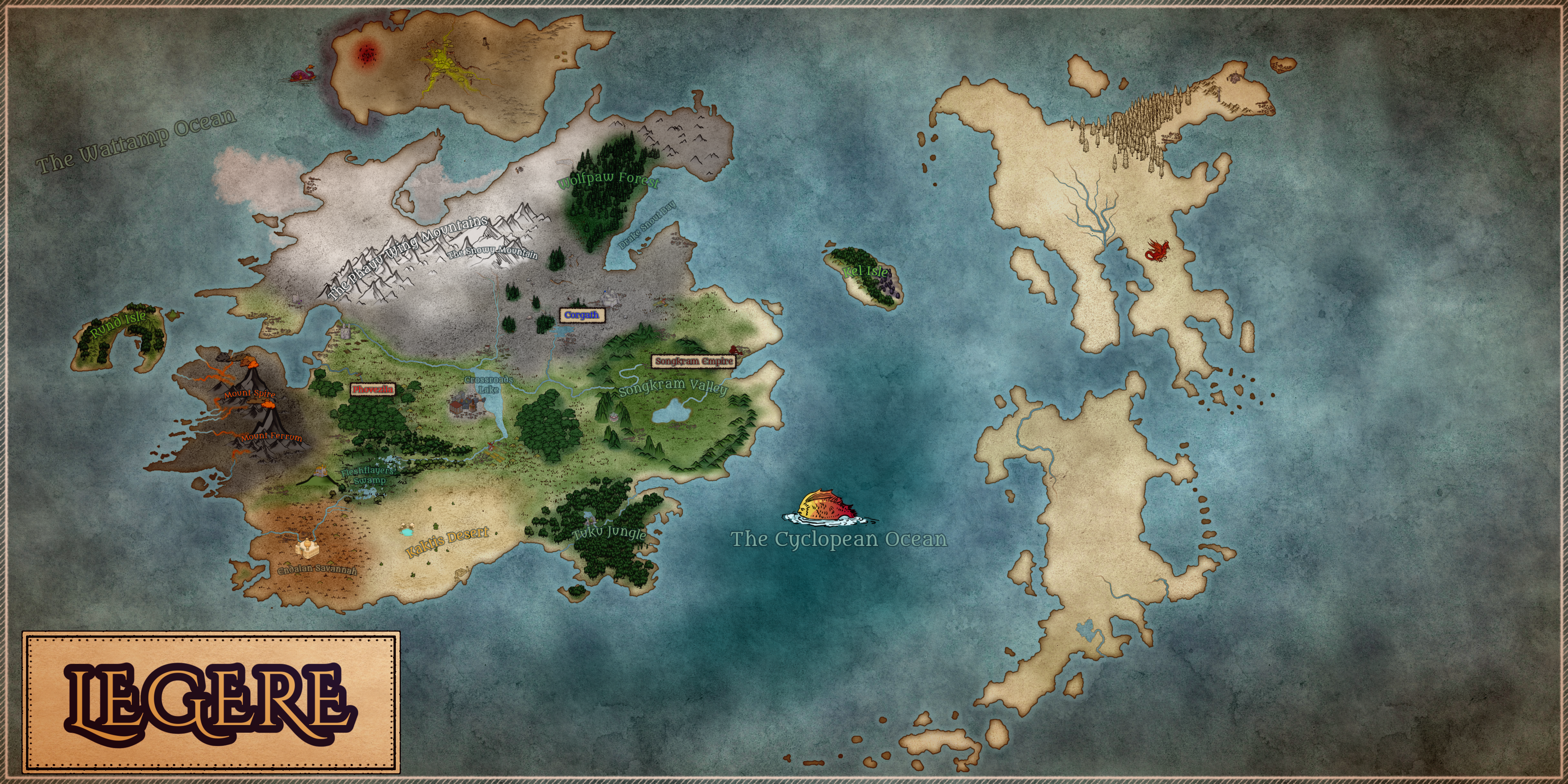
The Planet of Legere
Storm Years
Storm Year
Legere had an interesting climate partially dictated by fields of magic that pulsated periodically. Every 5 years, a “Storm Year” would occur—a period of harsher climate.
A simple way to remember: every year that ends in 9 or 4 is a storm year!
A Storm Year manifested differently in various locations. For example, in Nungul/Destral, Storm Years were characterized by an intense, thick, obfuscating fog.
Link to originalThis Article is a Stub
There is more canon information that exists on this topic and will be added to this page later.
Continents
Legere had two continents: Hohm and Fereina.
Hohm
Hohm was the continent of Legere that had an uninterrupted history in the sense that the civilizations that were established upon it were never extinguished fully. It was also the primary continent for theatres of battle during the Demon Wars.
Hohm’s significant landmarks included the awesome Mount Ferrum; the Phayu Wing Mountain Range crowned with The Snowy Mountain; the bifurcated Crossroads Lake; the Kaktis Desert; and the lush Sangmyung Valley. Hohm featured many large islands just off of its mainland coasts, including Rund Isle, Dawn Isle, and Kel Isle.
Hohm was the origin of duns, Mylembo and the Tslakla.
Fereina
The continent of Fereina consisted of two halves: North Fereina and South Fereina. The middle of the two halves was bisected by a sea passage, known as The Winding Strait.
Fereinite societies were largely wiped out during the Amaranthine Reaping in 470 PBD, with the exception of some more well-isolated nations like Veskovia. Most Legerians—especially after the Demon Wars—were unable to remember the time when Fereina was as populated and as lively as Hohm. However, during the Ancient Era1, many explorers from The Eastern Provinces, Corgath, and Phovezila began to rediscover Fereina’s lands and establish colonies (especially along the edges of the Winding Strait).
Fereina had a sprawling, diverse mainland, but was also peppered with a plethora of archipelagos.
Fereina was the origin of (PLACEHOLDER)Kiwi People and (PLACEHOLDER)Carved People.
History
For a comprehensive look at major world events on Legere, refer to the Timeline.
Suggested reading: Amaranthine Reaping, Demon Wars, Legerian War
The Subterranean World
Known by many names, like the Legerian Underworld, the Deep Realms, or simply The Underground among other terms, the subterranean world of Legere spread across the planet through winding, twisted caverns. Most of the caverns below Hohm were occupied by the Naga. The underworld of Fereina, like its surface, were rid of naga civilization during the Amaranthine Reaping. Mylembo also spread throughout the underground after their populations on Kel Isle grew too big.
The Oceans
Much of Legere was covered in water. There were two main oceans that coated its surface. They were separated by Legere’s two continents, although they were linked through The Winding Strait.
Wattamp Ocean
East of Fereina and west of Hohm was the Wattamp Ocean. The Wattamp was treacherous to sail because of many sandbars and shallow areas—expert navigators were needed to sail the Wattamp without accumulating severe damage to a ship’s hull or accidentally running aground.
The Wattamp had several large stretches of extremely shallow water. These shallow water areas could be as shallow as 3 feet, and could cover areas of up to 2 square kilometers.
Link to originalThis Article is a Stub
There is more canon information that exists on this topic and will be added to this page later.
Cyclopean Ocean
Named after its notorious yet thankfully scarce resident1, the Cyclopean Ocean spread out from the east of Hohm to the western shores of Fereina. The southern regions of the ocean were significantly deeper than the north.
Link to original Footnotes
The Legerian Planes
Legere was a realm with many planes of existence—many of which existed to support various types of magic.
The following is a non-exhaustive list of some of Legere’s planes:
The Legerian Cosmos
The Moon
The moon over Legere was made of a pale grey rock. It orbited around Legere elliptically. At night, it reflected the light of the sun to bring brightness to the otherwise consuming darkness of night.
The moon went by many different names, depending on the Legerian culture. In Tradespeak, many were happy to settle with the name of “The Moon”.
The Sun
Legere orbited a yellow star that provided great light and heat to the planet, promoting habitability. It also expelled a form of arcane radiation which could be harnessed magically for certain things.
The Sapients of Legere
As a prominent higher dimension, Legere was the home of multiple sapient races.
Sapience
Mortal Sapients
Across Creation were creatures broadly classified as sapient. Sapient beings were special among the other creatures within their dimension—they carried with them prominent aspects of the Creator (as a child carries the aspects of their father), and they were endowed with a triune being, a special right given to those favoured by the Creator Himself.
Triune beings’ elements were body, spirit, and soul.
Link to original
Legerian Religion
Religious Perspectives
Across all dimensions, fragments of the truth of Creation—namely that it was created by a primordial, all-powerful yet benevolent entity—were revealed through the nature of the world being observed. While the residents of some dimensions interacted directly with supernatural forces (especially in the wake of Demonic incursion) and therefore gained firsthand knowledge of The Creator, many other dimensions simple began to worship yet-to-be fully realized images of Him.
Link to original
Like practically all higher dimensions, Legere had multiple religions revere The Creator even before the revelation of the supernatural in the wake of the Demon Wars. For example, the followers of The Waymaker.
Further Reading on the Multiverse
Footnotes
-
5 - 157 DHT ↩