Paladins, or Holy Knights (often abbreviated from Holy Knights of the Righteous Order) were the militants of the Righteous Order. They served to enact the Righteous Order’s purpose: to defend Legere from threats profane and alien.
Recommended additional reading: Righteous Order, Righteous Fort
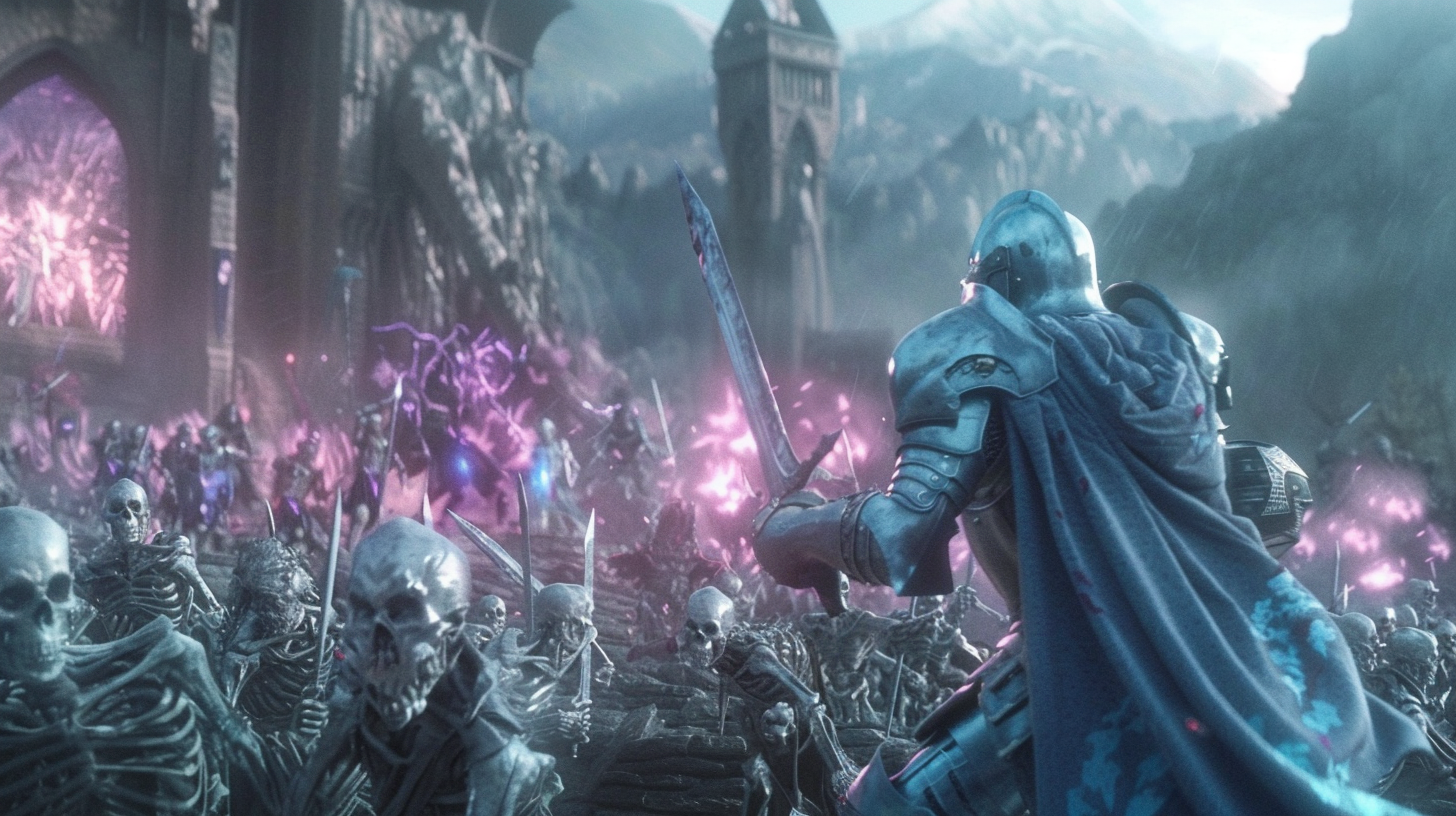
A paladin confronts a squad of undead warriors guarding the main gate of the Stone City during the Battle of Nokkville.
Equipment
Fire Iron Arms & Armour
Paladins were given equipment made of Fire Iron, one of the hardest naturally occurring metals in all of Legere. This made them formidable opponents capable of shrugging off all sorts of edged weapon strikes and projectiles. They were comparable to the heavily armoured cataphracts of Jinifar, but not nearly as heavy/reliant on a horse for mobility. Their weapons were also extremely durable and able to hold their edges no matter what kind of target they struck.
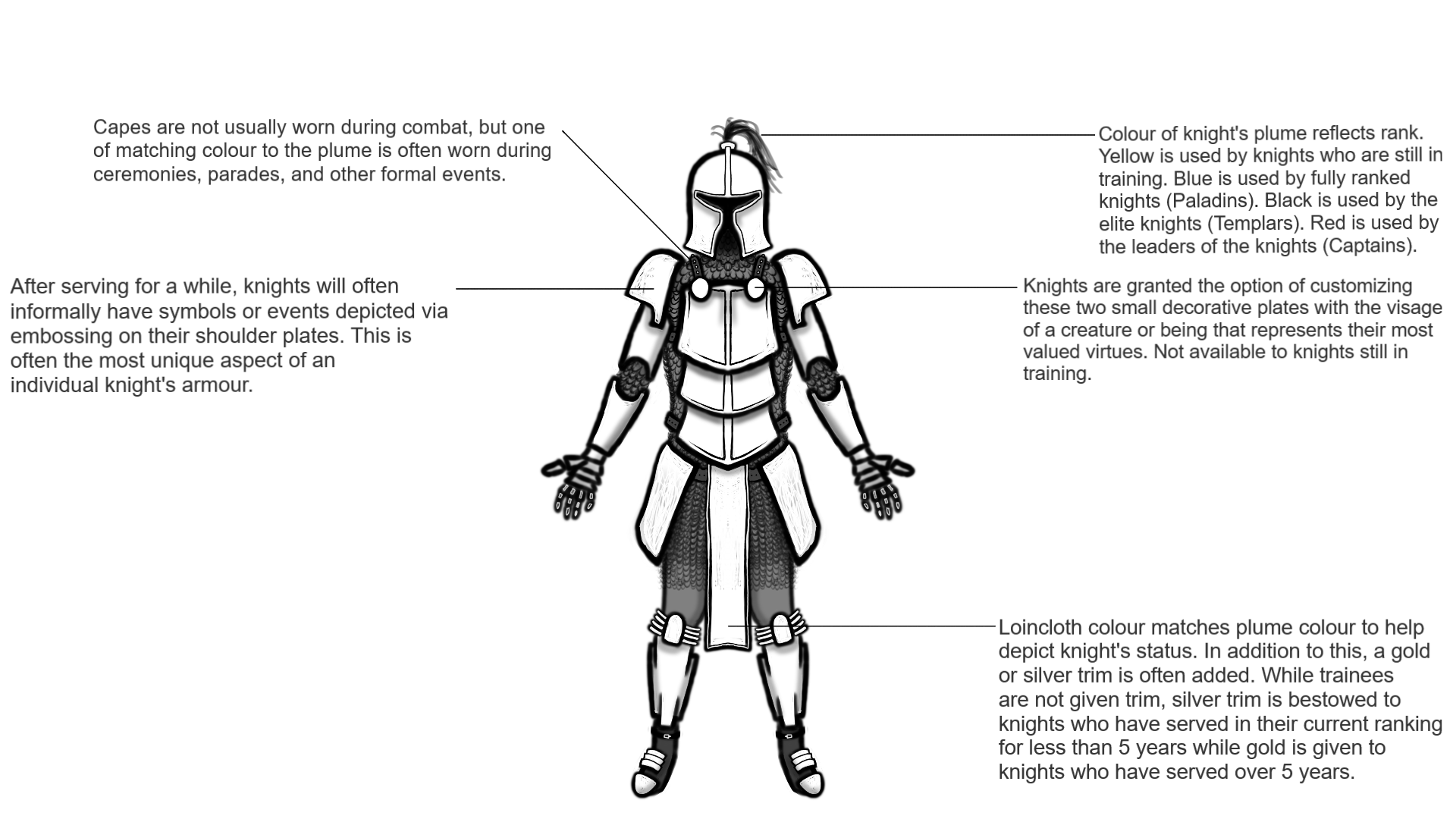
Paladins would often customize their armour to a great extent to reflect their personality and help identify themselves on the battlefield. Said customization typically manifested as decorative embossing or engravings made on the armour’s pauldrons and rondels.
The Ring
Paladins wore a fire iron ring on their dominant hand’s pinky finger. Engraved with the same holy rune found on the Holy Tome’s cover, the ring was a constant reminder to the wearer about what they stood for: their oath to righteousness and ethics above reproach. Should he shake a hand, write a document, or wield a sword, a paladin would be reminded of his responsibilities and tenets of faith.
The ring itself wasn’t magical or a cornerstone for a paladin’s powers, but paladins did make efforts to keep the ring polished and well-maintained. Dead paladins were rarely buried with their rings—they were recovered when possible and put into large display cases alongside memorials in the Righteous Fort as a testament to past service. In rare cases where paladins departed from the Order, an attempt to reclaim the ring would be made, and the ring would be given to a newly knighted paladin of promise.
Relic Weapons
In dire situations, the Forge Priests could choose to forge one of 10 relic weapons, arming a paladin with supreme power that was nearly unmatched in all of Legere. Each relic weapon could only be forged once in all time, meaning that building one of these weapons was done incredibly sparingly. Like the Divine Powers wielded by paladins, the relic weapons would refuse to function properly when wielded in ways that would be evil.
The Ten Relic Weapons
The Suppressor
A longbow without a physical string—instead, it was bound by a strand of golden light that summoned bolts of light capable of piercing armour. It could produce its own ammunition. However, after firing about 25-30 arrows, the bow’s light would fade while it “recharged” for approximately 3-5 minutes. With bowstring and arrows made of light, it could be drawn and fired extremely quickly, and the arrows were not subjected to gravity.
As a safeguard, the Suppressor would not fire an arrow if an innocent soul would be hit. This would be extremely useful in heavy combat scenarios where conflict is intense and potentially confusing.
The Suppressor was forged in 274 DHT when the Angels called forth Ladodon II and Archoth II to form the Archangel’s Heroes. It was wielded by Archoth throughout his career as a Hero of the Archangel.
The Demonhunter
A steel wave-bladed greatsword decorated with rubies and ornate gold patterns along the length of its blade. A divine aura permeated the weapon’s blade, which would allow it to inflict deep cuts without physically entering deep into an opponent’s body. While this is would only be effective against foes with little to no armour, the Demonhunter would also inflict a painful sensation with its pommel, regardless of whether or not the weapon actually caused any real damage.
If stabbed into something, the Demonhunter could be “locked” into place. This would disallow anything from removing the blade without destroying the object the weapon was lodged in.
The Credo Gauntlets
While not technically weapons, this pair of steel gloves could be used once a knight was disarmed. However their power would lie not in their offensive capability, but rather in defense.
The Credo Gauntlets would allow the user to summon a shield of light by raising their fist up. This shield would only for about a minute, but it would be completely impossible for anything to penetrate it.
The Guiding Light
A poleaxe that would imbue the wielder with a heightened limit for physical activity. Things like stamina and the ability to heal from wounds would be increased while the effects of hunger and pain were lessened.
The Guiding Light would also be able to summon a beam of light from the sky like a beacon, creating an aura of divine power around the wielder. This would grant those allied with the wielder the same healing and resistances.
The Sunblade
An arming sword with a dark coloured blade, golden crossguard and sapphire-infused pommel. When drawn from its sheath, the blade would glow orange, becoming hot to the touch. The wielder could command the blade to become hotter, causing it to glow even brighter and emit licks of flame. Its temperature could reach so high that it would melt through armour and burn through shields like they were nothing.
The Sunblade could also burn white-hot, blinding those who looked at the weapon while scorching those who remained too close. The weapon could also discharge its heat as a fiery projectile. Both of these effects were useful, but would cause the weapon to lose its supernatural properties for a short duration.
As a third ability, the blade could also be laid upon a shield to imbue that shield with the imagery of a burning crucifix. While wielding a marked shield, the wielder would be able to discharge a fiery nova from it. The shield would likely be destroyed in the process by either burning up or melting out of shape.
It is important to note that the Sunblade lacked many of the smart targeting and “safety” features found in other Relic Weapons, but this is offset by its slightly greater power. The Sunblade was forged in 330 DHT after General Xadu was freed from the Demon Prison. The weapon was forged and given to Sir Dafern once he joined the Archangel’s Heroes.
The Judge
A warhammer coated in gold with a diamond striking face. The crystalline head of the hammer was unbreakable while the metal frame behind it would change its mass at the user’s will. This allowed whoever used it to swing it while it was light to gain incredible speed before increasing its mass to the extreme at the moment of impact. This would deliver a blow so powerful that it would send the opponent struck flying away, assuming they weren’t liquified on impact.
The Arbiter’s Pride
A pike with a shaft made of silver and a head of gold. It was incredibly light, allowing for deft, precise movements despite its length while delivering fatal stabs with its extremely sharp point.
The Arbiter’s Pride would also be capable of summoning a secondary spearhead made of divine energy overtop its physical point. This would increase its reach by an extra foot, which would allow the wielder to take an opponent by surprise after they’d become accustomed the wielder’s measure. Additionally the Arbiter’s Pride could be teleported back to its user’s hand after being thrown or otherwise being absent from their hand.
The Arbiter’s Pride was forged a few years after the Suppressor was created. While the Forge Priests had agreed to forge it alongside the Suppressor when Archoth and Ladodon were given their divine objective, Ladodon declined using the weapon since he felt he did not want to rob the Holy Forge of two weapons in a single day. Later on the Arbiter’s Pride was forged for Ladodon when more intense evils rose up to meet the Archangel’s Heroes.
The Sacrosanct
A crossbow built to fire exploding bolts. While the crossbow itself wouldn’t appear extraordinary compared to an average crossbow (save for the fanciful decals), the bolts fired by the crossbow would become enchanted with holy power as soon as the trigger was pulled. Bolts fired from this weapon would increase in speed the longer they were in flight, allowing them to deliver more damage the further the shooter was from their target. While the requirement for ammunition would be a downside to this weapon, it was capable of using any crossbow bolt found.
A few seconds after contact, the bolts would explode, unleashing a ball of blue fire capable of melting away flesh and breaking open even the toughest armour. Crossbow bolts would not explode if the explosion would potentially injure an ally or the shooter, allowing the weapon to remain useful even in situations where allies were close proximity to opponents, as well as point blank range.
The Sword of the Heavens
A longsword with a lustrous blue-tinged blade. The sword could be commanded to move by the wielder, flying forward to strike foes at a distance as a floating weapon. Additionally the sword could lift the wielder a few feet off the ground as long as the handle was gripped. When making strikes, the sword would actively veer off course if an innocent target was in its path.
The sword would also automatically unsheathe itself and parry an attack made against its wielder if they were unprepared.
The Blessing
A golden mace with a marble handle. With every strike from this powerful weapon, a powerful shockwaves would emanate from it, blowing away targets who opposed the wielder.
The Blessing could also be thrown like a grenade, causing the shaft to explode into hundreds of shard of stone, tearing through opponents before reassembling back into one piece in the user’s hand. While less effective against armoured opponents, it would be able to easily catch targets off guard from afar.
Link to original
Becoming a Paladin
There was no age limit on starting down the path of holy knighthood. Neither were there restrictions based on background—becoming a paladin was something anyone could do, since all of the Order’s members would eventually be sorted by the divine powers that the Order submitted to. There were a few exceptions, such as those who were of sufficiently advanced age—a paladin needed a strong, vital body to serve with.
Once accepted, a prospect of the paladins—called a squire—would become the student of a paladin venerable. After 5 years of tutelage under their master, the squire could qualify to become a paladin themselves. The paladin venerable would have to present their squire to their own master—their knight captain. If the captain deemed the squire worthy, the captain would knight them in a ceremony that involved signing The Holy Tome, acquiring a fire iron ring, and receiving a new set of Fire Iron armour complete with the blue embellishments that were so iconic within the Righteous Order’s knights. Upon completion of the ceremony, the squire acquired the honorific of “Sir” and could officially be called a paladin, or holy knight.
Paladin Streams
A paladin had to serve for at least 5 years before advancing in their career within the Righteous Order. Upon their fifth year of service, a paladin would receive a epithet and move into one of the following progression streams:
Paladin Venerable
A paladin venerable was an elder, experienced member of the primary combat corps of the Righteous Order. They held no official authority over other paladins, but were often consulted by them due to their wisdom and experience.
Paladin venerables did hold the responsibility of training squires. A single paladin venerable could train up to two squires at a time, although certain exceptions could be made in outlier circumstances.
Paladin venerables would often be reconsidered for advancement to captain or templarhood with every passing year of service. They had no obligation to accept an offer of advancement, with many paladin venerables content with continuing to serve as they had been.
Like yet-to-be-venerable paladins, paladin venerables bore blue cloth, capes, and plumes to signify their membership to the backbone of the Righteous Order’s fighting force. However, their tabards and capes were embroidered with gold to distinguish and honour them.
Knight Captain
Working under The Four were the captains. Captains worked together to direct troop movements on the battlefield, and ensured that strategies were executed smoothly. Captains also worked individually to lead smaller squads of knights. The Four elected as many captains as they wanted as often as they felt necessary.
As representatives of The Four, knight captains were responsible for conducting knighting ceremonies, officially inducting squires into holy knighthood. While any captain could knight any squire, typically the squires of paladin venerables who reported to a captain would be knighted by that particular captain.
Bearing red plumes and tabards, knight captains stood out from the blue-clothed legions of the Righteous Order.
Knight Templar
Templars were the elite knights of the Righteous Order, taking orders directly from The Four. They were handpicked from the paladins in the same way captains were picked. The Four usually chose templars if they showed the proficiency in combat equal to a captain, but without the aptitude for military leadership, scholarly studies, tactical planning, and other more cerebral tasks.
Before, and even during the time of the Archangel’s Heroes, templars served as lone operatives or in small steelteams to accomplish covert operations where larger movements of the Righteous Order could be seen as hostile or invasive.
Knight templars were dramatically clad in black robes with matching plumes—a striking appearance when combined with the gold embroidery lining their cloth.
Divine Powers
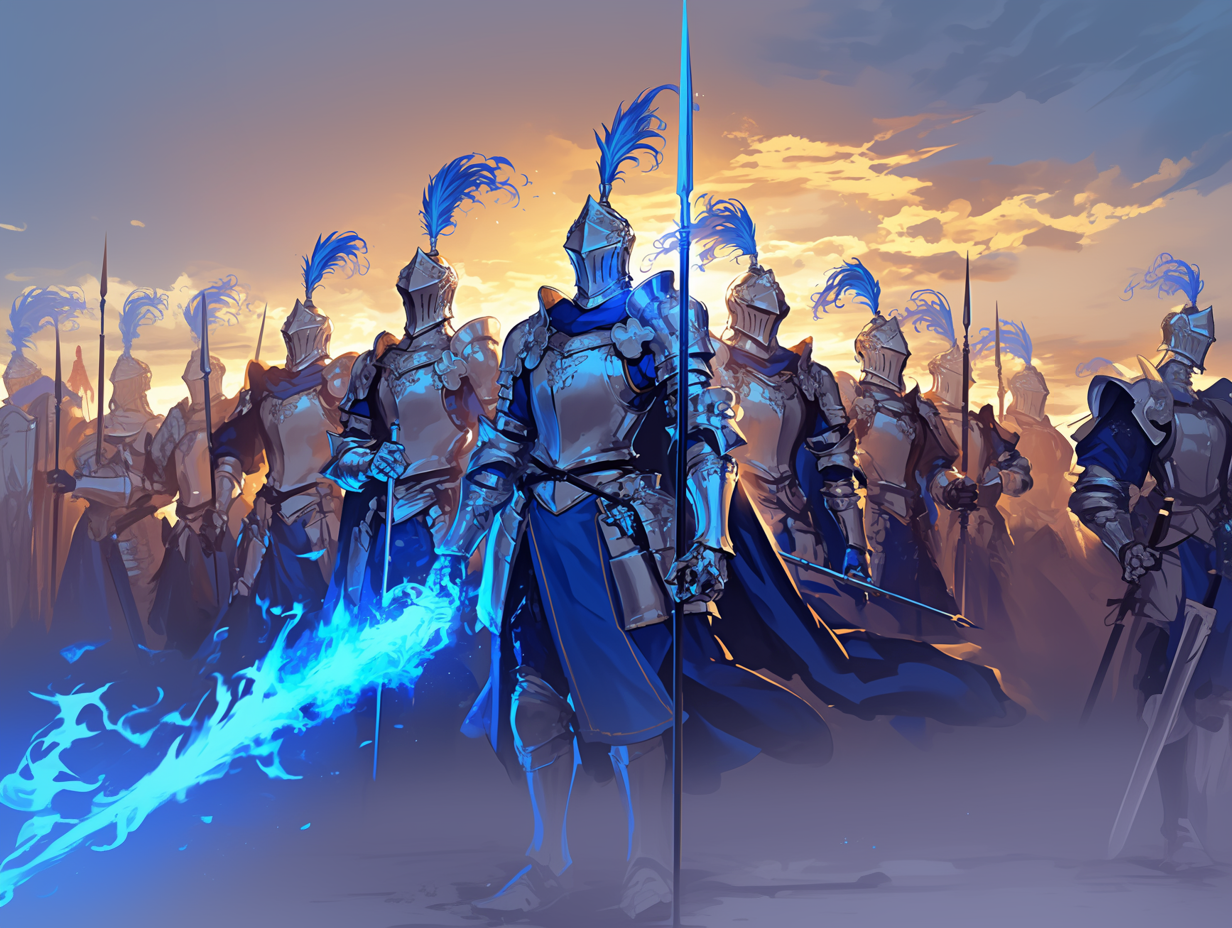
Upon a squire’s graduation, they were subjected to a ceremony of honour to celebrate their hard work and dedication. Squires were knighted by The Four, and permitted to write their name in the Holy Tome. The Tome granted powers like higher strength, greater speed, resilience to disease, and improved reflexes in equal measure. Every paladin received a different divine gift, allowing every member of the order to contribute to its mission in different ways.
Some of the more incredible powers that manifested in paladins included the ability to bathe an ally in a holy light, healing minor wounds and alleviating pain. This was incredibly useful on the battlefield, as many paladins could serve as both warrior and medic. The paladins could also call upon holy fire to dwell in their weapons.
Being divine, the Holy Tome’s gifts couldn’t be abused for power. Those who attempted to acquire the Tome’s power and then use it for evil/otherwise selfish reasons were consumed on the spot by a fierce pillar of heat from the sky. It took many years of dedication for a squire to get access to the Holy Tome, which alone deterred most would-be evildoers. However, the constant threat following the misuse of holy powers kept paladins in line. They may make mistakes from time to time, but they practiced the self-control needed to prevent themselves from lashing out with their divine might in a fit of hatred.
Documented Divine Gifts
The following is a non-exhaustive list of divine gifts that paladins throughout the history of the Righteous Order had acquired. The Order did its best to document all known forms of divine gifts, but occasionally new ones never seen before manifest.
| Divine Gift | Powers & Manifestation | | :--------------------------------: | :------------------------------------------------------------------------------------------------------------------------------------------------------------------------------------------------------------------------------------------------------------------------------------------------------------------------------------------------------------ | | Blessing of Clear Eyes | The paladin had extremely good eyesight, being able to see things at ranges that rivaled even the greatest of vasamancers. | | Blessing of Great Reflexes | The paladin had supernaturally fast reflexes, becoming capable of reacting to things in under 100 milliseconds. | | Blessing of Healing Light | The paladin could call down a brilliant, divine light. Those who were bathed in the light were granted temporary but potent freedom from pain, and even mortal wounds could be closed up. In some cases, paladins could send deliverance from disease to those they healed. | | Blessing of Incorruptible Health | The paladin was immune to mortal diseases, including the most sinister of afflictions like manikinism or even Witch Rash. | | Blessing of Iron Flesh | The paladin’s skin was supernaturally tough, refusing to be penetrated or lacerated by most weapons. | | Blessing of Prognostic Sight | The paladin had some sort of prophetic power. This could manifest in a variety of ways, such as visions or just words that forced themselves to be spoken over others. Some paladins’ prophetic visions saw days, months, or even years into the future. Others could see the immediate future, making them effective warriors that could foil most ambushes. | | Blessing of the Angels’ Swiftness | The paladin could run and move at great speeds. Typically achieved speeds were still subsonic, but impressive enough to be noticed. | | Blessing of the Creator’s Strength | The paladin gained supernatural strength. The strength varied from paladin to paladin, but often enabled paladins to ignore lifting restrictions imposed by inertia. | | Blessing of the Seraphim’s Flames | The paladin could conjure forth supernaturally hot, azure tongues of flame. |